The World Bank warns that the AI revolution could exacerbate inequalities between rich and poor countries, as poorer nations struggle to benefit from AI advancements. Adebayo Alonge emphasizes the need for "small AI," tailored to local contexts, advocating for precision in development and funding to adequately support impactful applications that save lives.
Category: Solutions To Global Challenges
The Billionaires Are Automating Your Job. They Should Pay for It.
A seventeen-year-old recognizes that traditional college paths are impractical in the AI-driven job market, advocating for trades instead. The automation era threatens numerous white-collar jobs, sparking calls for policies like taxing automated labor and funding universal income. The article emphasizes the need for proactive societal adjustments to avoid economic disparity.
Sovereign AI Is Not a White Paper. It Is an Infrastructure Decision.
Lee Kuan Yew built Singapore's strategy not by copying the West, but by understanding Singapore's constraints. Every government in the world wants an AI strategy. The UK just launched a £500 million Sovereign AI Fund. India committed $1.2 billion to its National AI Mission. Saudi Arabia, the UAE, and France are spending billions more. By … Continue reading Sovereign AI Is Not a White Paper. It Is an Infrastructure Decision.
The AI Arms Race and Why Small Nations Need a Seat at the Table
The content emphasizes the urgent need for small nations to build robust data infrastructure and capacity before asserting data sovereignty in the fast-paced AI arms race. It advocates for a strategic approach where nations first focus on foundational elements like data centers and skilled talent, rather than simply demanding sovereignty without the means to enforce it.
When 95% of Entrepreneurs Cannot Access Capital, You Do Not Have an Economy — You Have a Lottery
Poverty is the worst form of violence." — Mahatma Gandhi In May 2026, a mathematics teacher named Michael Oyedokun was murdered in rural Nigeria. He was pulled from a school. He taught algebra and geometry — the precise disciplines that nations like China and India elevated to strategic national priority, building export-driven economies that lifted … Continue reading When 95% of Entrepreneurs Cannot Access Capital, You Do Not Have an Economy — You Have a Lottery
The Convergence — How AI and Clean Energy Are Building the Same Future
Bitcoin mining companies are shifting focus to artificial intelligence, anticipating a surge in revenue from AI workloads. With over $70 billion in AI contracts emerging, the need for energy is critical. This convergence of AI and clean energy presents opportunities across sectors, driving both innovation and sustainability in infrastructure.
The Cold Chain Gap — Why $35B in Vaccines and Food Spoil Every Year and How Solar Fixes It
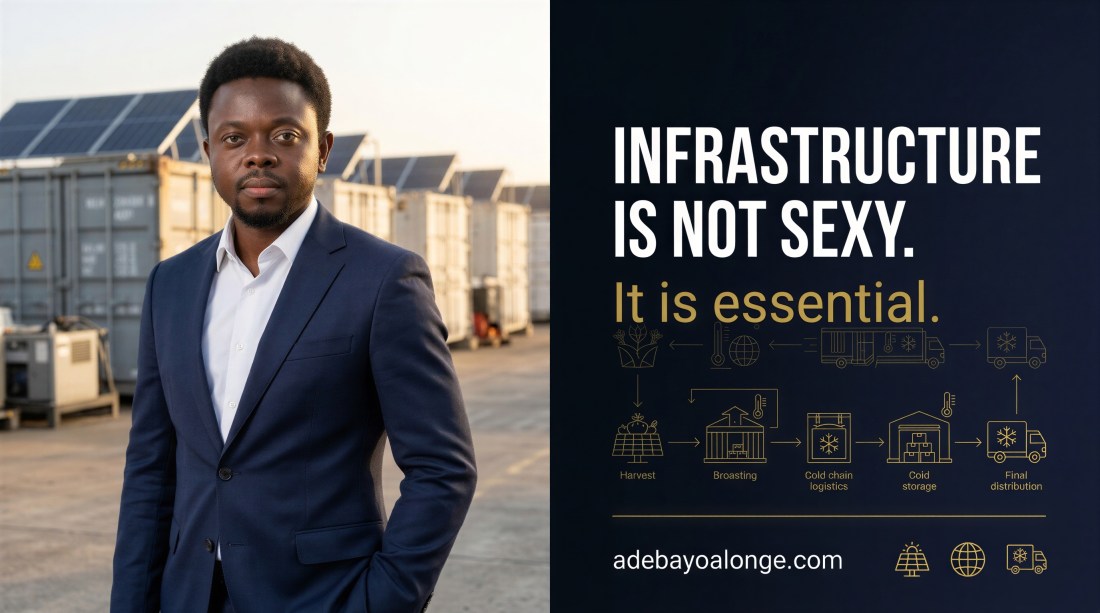
Cold chain failures cost the world $35 billion annually, wasting up to 50% of vaccines and contributing to significant food loss. This issue arises not from a lack of technology, but from misdirected investments favoring developed markets. Solutions include decentralized solar-powered units and integrated models serving both health and agriculture, emphasizing necessity over luxury in healthcare infrastructure.
Three Degrees, One Lesson — Why Credentials Are Tools, Not Destinations
The author, a graduate of prestigious Ivy League institutions, argues that elite credentials should be viewed as keys to opportunities rather than endpoints. He criticizes modern graduates for failing to leverage their education by settling for comfort and safety instead of pursuing meaningful work and challenging norms. Emphasis is placed on remaining active and engaged in impactful endeavors.
Trust Is Infrastructure — Why the Most Important System You Can Build Is Credibility
Trust is a system that can be structured for effectiveness, yet institutions are struggling with public skepticism. Compliance-driven approaches fail to address underlying trust issues. Successful solutions redesign systems for transparency and verification, improving adoption and building credibility. The future favors those who establish robust trust architectures over mere reputational marketing.
The AI Governance Gap — Why Algorithms Need Conscience, Not Just Compliance
The EU AI Act, enforcing significant penalties for noncompliance, seeks to regulate high-risk AI systems, emphasizing moral governance alongside technical compliance. While necessary, this framework lacks moral architecture, risking harm despite adherence to rules. Builders must prioritize community needs to ensure AI systems serve and do not exclude vulnerable populations.