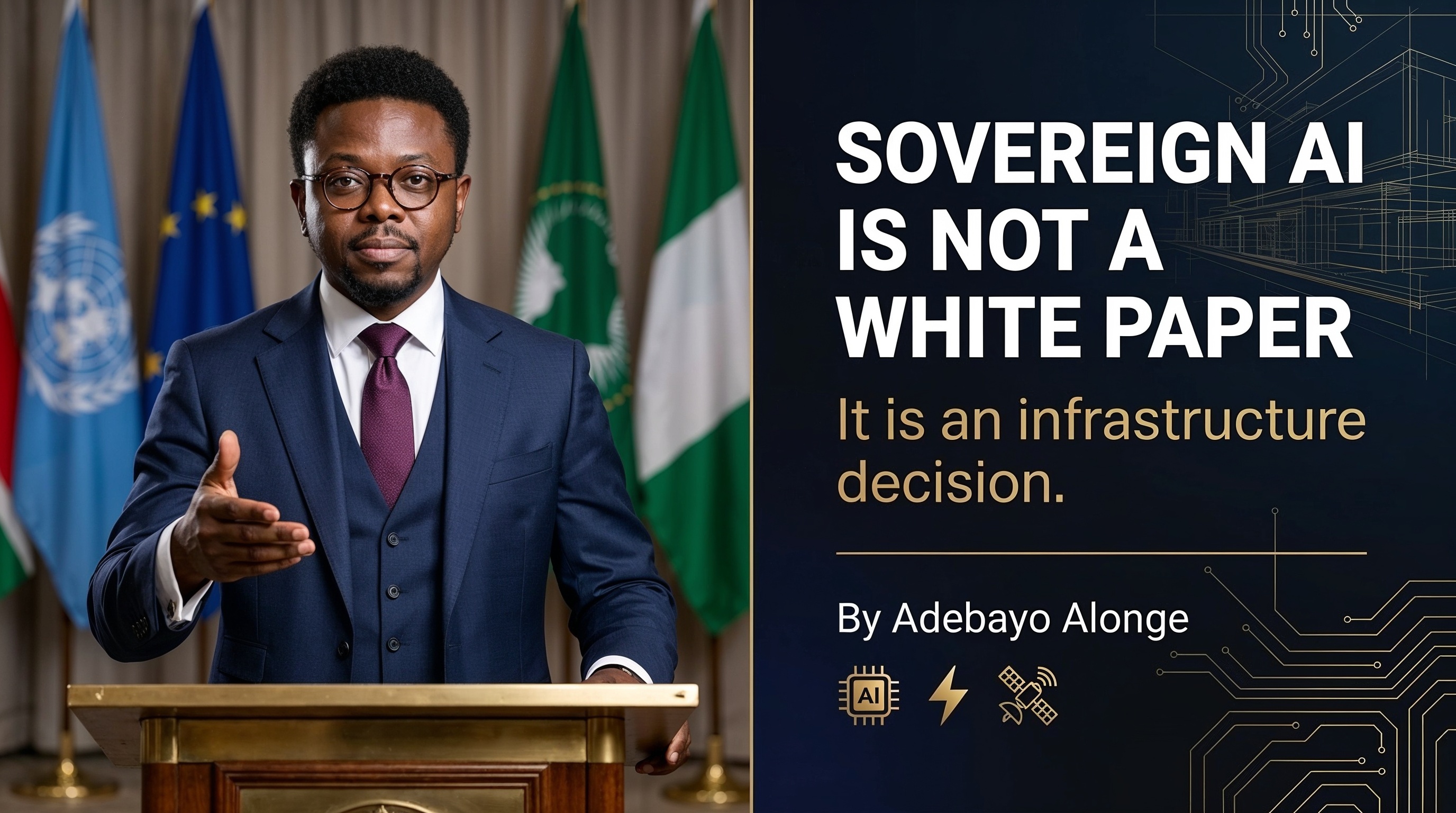
Lee Kuan Yew built Singapore’s strategy not by copying the West, but by understanding Singapore’s constraints.
Every government in the world wants an AI strategy. The UK just launched a £500 million Sovereign AI Fund. India committed $1.2 billion to its National AI Mission. Saudi Arabia, the UAE, and France are spending billions more. By mid-2026, sovereign AI is a budget line in most of the G20.
But most countries are building the wrong thing.
They are copying frameworks. Importing regulatory language. Hiring consultants who recycle the same playbook they sold to the last government. And the result is always the same: a document that sounds impressive, signals ambition, and changes nothing.
I have seen this failure up close.
The Minister and the Open Call
A colleague from the tech community was appointed ICT minister in an African country. Smart. Ambitious. Well-connected. His first move was to announce a national AI policy initiative and invite every diaspora AI founder he could reach to participate.
I was invited. I declined.
Not because the goal was wrong. Because the method was backwards.
A serious country that wants to build an AI strategy does so with a small number of its sharpest minds — in the quietest room — before inviting public input. Your brightest minds set the architecture. Then the public makes it robust. Not the other way around. Too many chefs in the kitchen do not improve the meal. They ruin it.
But process was not the real problem.
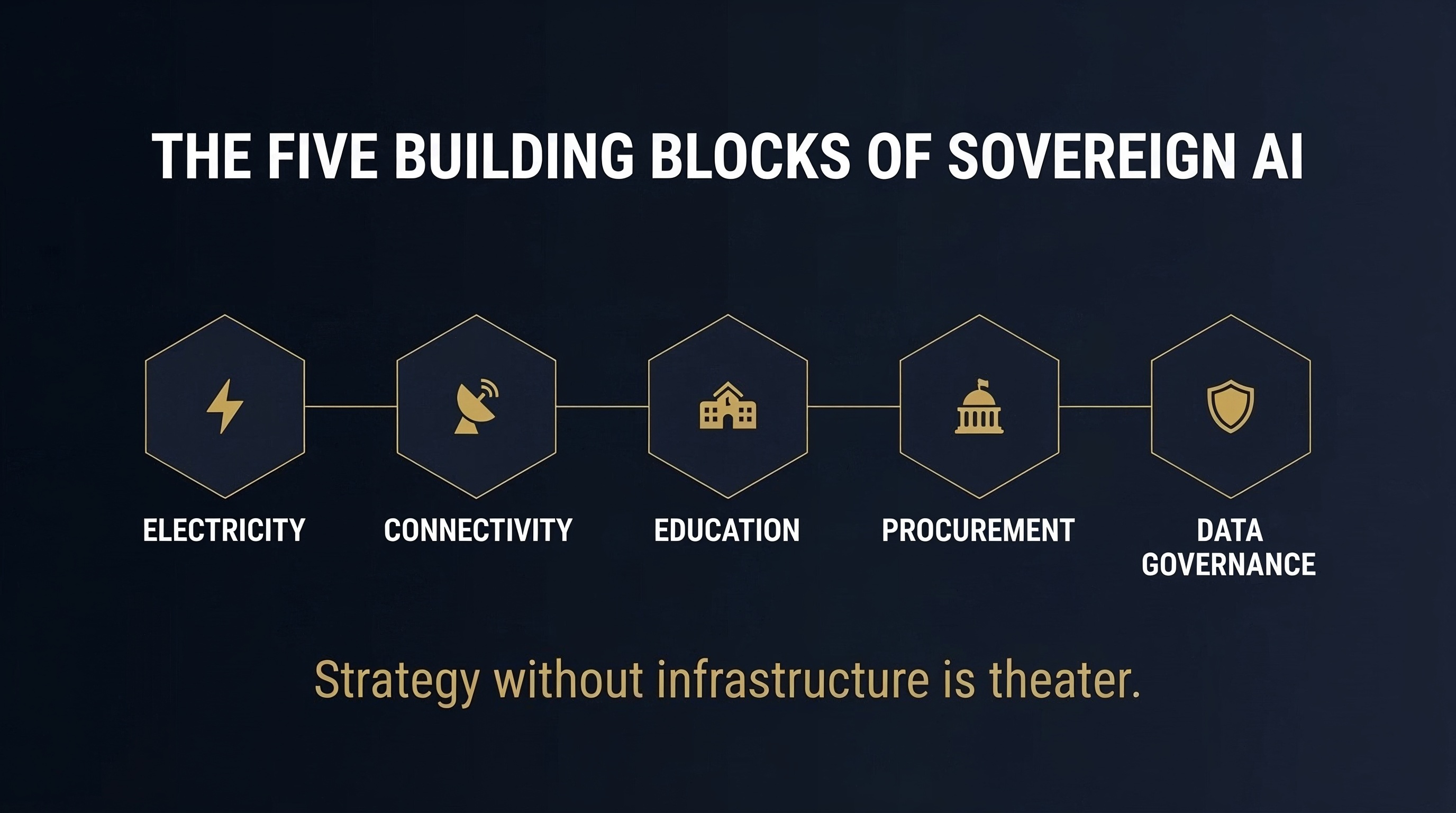
Strategy Without Foundation Is Theater
The deeper failure was that the strategy did not address the building blocks. It talked about algorithms, models, and innovation ecosystems. It said nothing about:
A. Stable electricity. You cannot run AI infrastructure on a grid that fails twenty three hours a day. Every data center, every edge device, every training pipeline requires consistent power. Without it, sovereign AI is a fantasy.
B. Reliable internet — including space-based connectivity. I even advised the minister directly: do not focus solely on fiber optic cabling. Add satellite-based internet that can reach every village, every school, every clinic. Starlink now operates in over 127 countries. Airtel Africa has partnered with SpaceX to bring direct-to-cell satellite connectivity across fourteen African markets. The technology exists. The strategy ignored it. That advice fell on deaf ears.
C. Safe digital learning environments. If your children and youth cannot learn safely in physical classrooms how can you even protect them online — if there are no guardrails for AI in schools — you are building an AI economy without the next generation of builders. Education infrastructure is AI infrastructure. My heart broke when I saw the dilapidated classrooms in which those kids in Oyo were kidnapped from. Many public schools in Africa look like that.
D. Government procurement of locally built AI products. This is the lever that most countries refuse to pull. Governments are the largest buyers in every economy. When they procure AI solutions built by local companies, they create demand. They create ecosystems. They create jobs. When they default to importing Western or Chinese platforms, they export their sovereignty with every purchase order.
E. Data governance that protects citizens. Forty-four African countries now have data protection laws. But laws without enforcement are decorations. Sovereign AI requires data infrastructure that keeps citizen data within borders and under national control.
F. Talent retention mechanisms. The best AI researchers and engineers in developing countries leave. Not because they do not love home — because home offers no funded runway to build. A sovereign AI strategy without a talent retention budget is a talent export program.
What a Real Sovereign AI Strategy Looks Like
The countries that will lead the AI era are not copying America or China. They are building from their own constraints. Here is the sequence that works:
First, secure the physical layer. Power. Connectivity. Both terrestrial and space-based. No AI strategy survives without reliable electricity and internet. This is infrastructure policy, not technology policy.
Second, build procurement mandates. Require government agencies to allocate a fixed percentage of their technology budgets to locally built AI solutions. Make the government the first buyer. This is how ecosystems are born — not from accelerators, but from purchase orders.
Third, design education and safety frameworks. Ensure AI tools deployed in schools are safe, age-appropriate, and supervised. Train teachers. Build curricula. Protect children. Ensure your kids are not kidnapped from their schools while they are trying to learn – that is just basic common sense!
Fourth, convene your best minds privately. Bring five to ten domain experts — AI researchers, infrastructure operators, healthcare systems builders, security professionals — into a small room. Design the architecture. Then open it for public input.
Fifth, enforce data governance. South Africa’s draft AI policy was withdrawn in April 2026 after it was discovered that the reference list contained AI-hallucinated citations. That is not governance. That is embarrassment. Sovereign AI strategies must be built by humans who understand the stakes — not outsourced to the tools they claim to regulate.
Build the Stack, Not the Slideshow
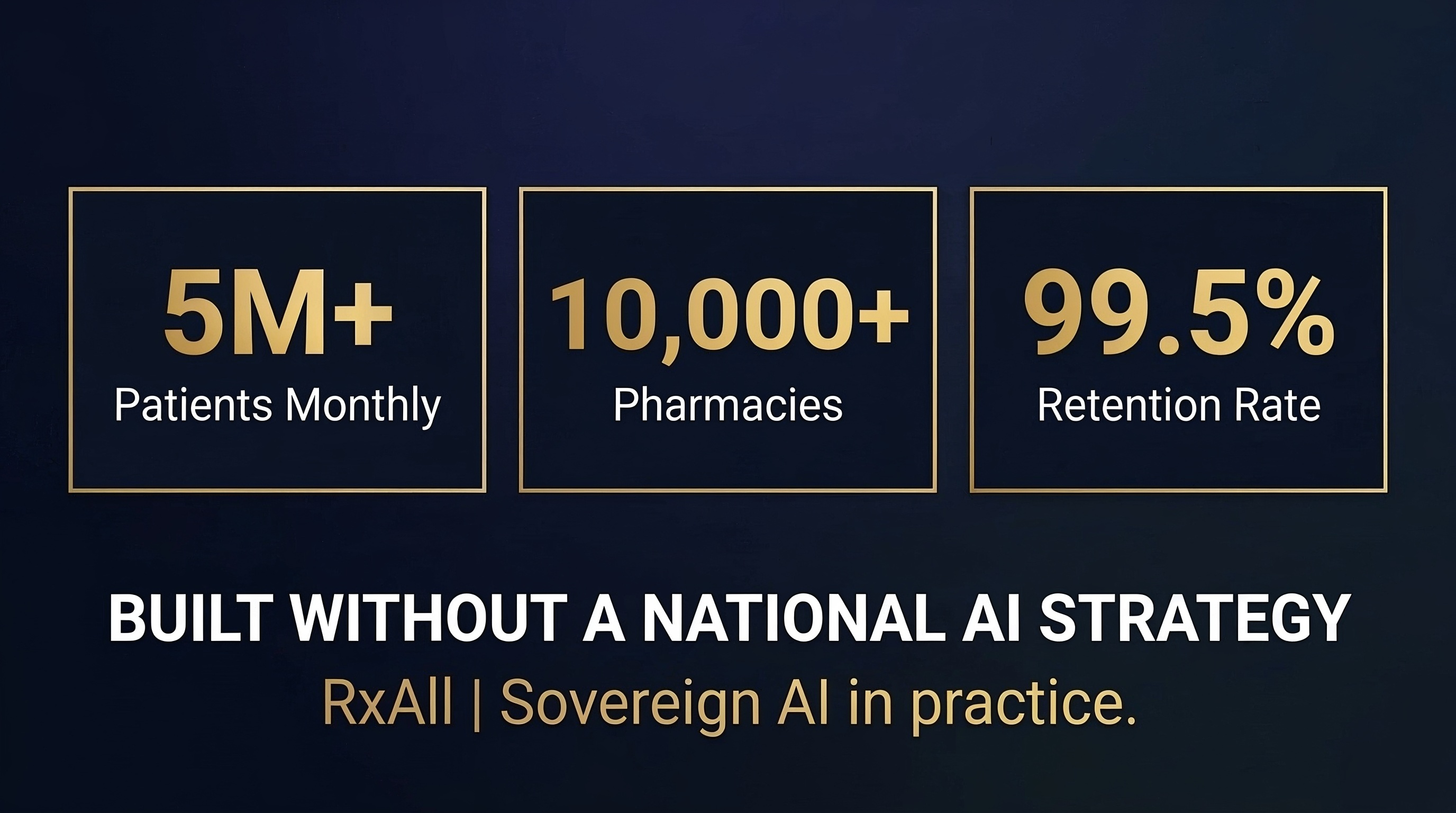
At RxAll, we did not wait for a national AI strategy. We built AI-powered pharmaceutical authentication from the ground up — now serving over five million patients monthly across more than ten thousand pharmacies with 99.5% retention. We deployed where the grid was unreliable, the internet was spotty, and the supply chain was compromised. We built for real conditions, not ideal ones.
That is what sovereign AI looks like in practice. Not a copied framework. Not a crowdsourced white paper. A built solution, designed for local constraints, serving local people, led by local builders.
Every country needs an AI strategy. But a strategy without electricity, internet, and local procurement is not a strategy.
It is a press release.
Onwards.
Adebayo Alonge is the Founder and Group CEO of RxAll Group. A Harvard Kennedy School Mason Fellow, Yale School of Management alumnus, and MIT Legatum Fellow, he builds AI-powered platforms that deliver healthcare, capital, and clean energy to underserved markets worldwide. He has raised $11M+ from Tier 1 VCs, driven $180M+ in product sales, and serves millions of patients monthly. He is a Fast Company World Changing Ideas 2025 honoree and winner of the Hello Tomorrow DeepTech Prize.
#SovereignAI #AIGovernance #DeepTech #GlobalLeadership #ArchitectOfOrder
Discover more from Adebayo Alonge
Subscribe to get the latest posts sent to your email.

