It is not the critic who counts; not the man who points out how the strong man stumbles… The credit belongs to the man who is actually in the arena.” — Theodore Roosevelt
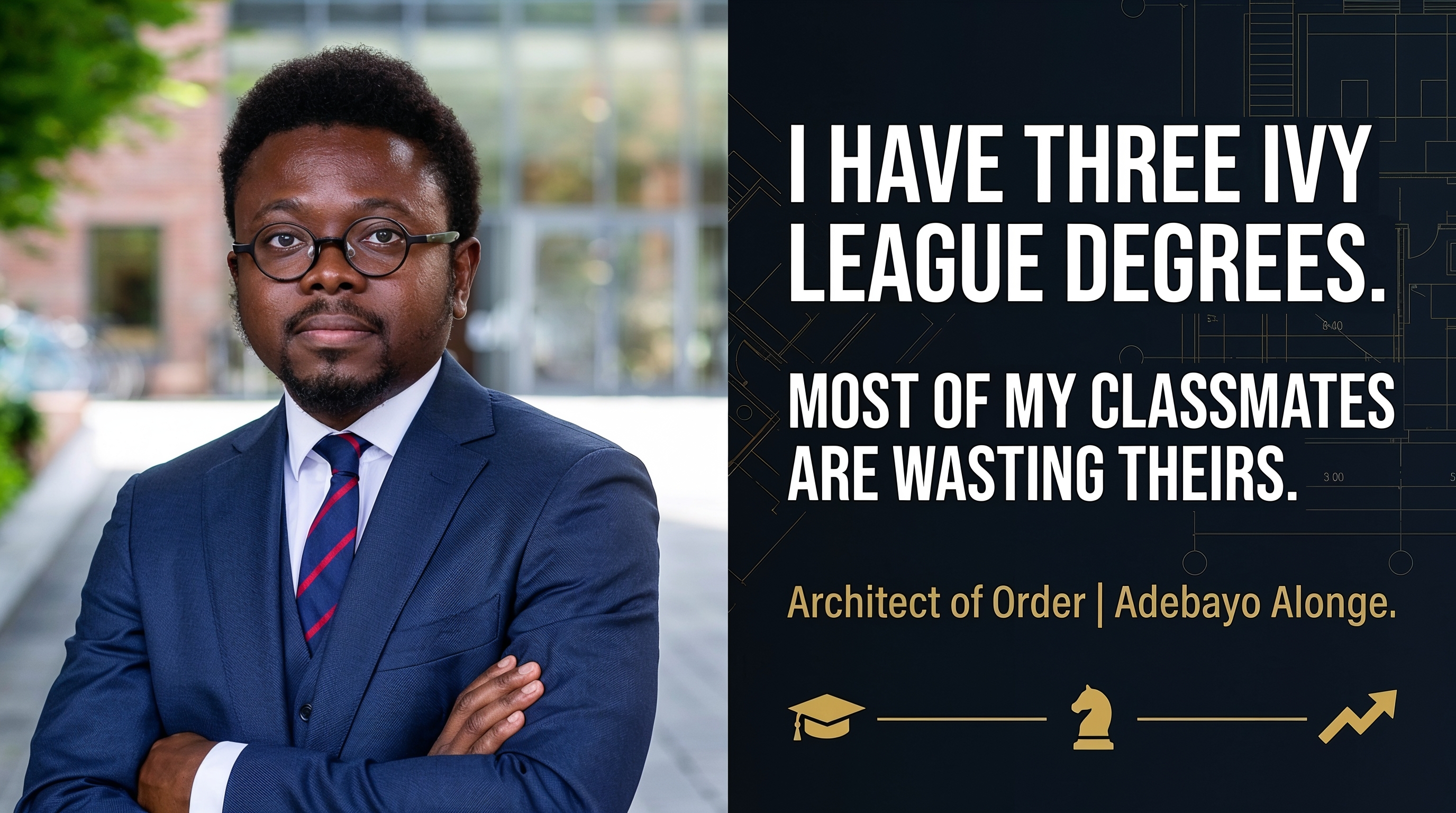
I have three Ivy League degrees. Most of my classmates are wasting theirs.
That is a hard sentence. It is also true. And the people most uncomfortable hearing it are the ones for whom it is most needed.
I went to Yale. I went to MIT. I finished at the Harvard Kennedy School as a Mason Fellow and a Cheng Fellow. Each one was a privilege. Each one taught me something I could not have learned anywhere else. But none of them made me. The work did. The arguments did. The willingness to point a sharp question at a powerful person while the rest of the room studied their shoes — that is what made me.
This is the essay I wish someone had handed me before I ever set foot in Cambridge.
The Promise and the Lie
Elite credentials sell two things at the same time. One is true. One is a lie.
The truth is that a Yale or Harvard or MIT credential opens doors that would otherwise stay closed. It moves your résumé to the top of the pile. It gives you a network of operators, capital, and policymakers that money cannot buy.
I have watched it open every door I asked it to.
The lie is that the credential is the destination. That you have arrived. That the work is done.
The credential is a key. The work is what you do once the door opens.
Most graduates confuse the two. They walk through the door and stop. They sit down. They get comfortable. They take the highest-paying salary they can find inside the room and never ask why the room exists.
That is how a generation of brilliant people becomes useless.
The Two Failures of the Modern Graduate
There are two failures I see, again and again, in people with the same degrees I carry.
Failure one: faux humility inside elite spaces. Smart people learn quickly that other smart people do not like being out-thought. So they soften. They round their edges. They stop asking the sharpest question. They settle into a kind of performance humility that keeps the room peaceful and the seating chart unchanged. The price of that peace is the ideas that never get spoken. The cost is paid by every person waiting outside the room for somebody inside to fight for them.
Failure two: the chase for safety. There used to be a time when Ivy Leaguers came out of those gates and built things. They ran for office. They went into frontier markets. They started institutions. They risked. They embarrassed themselves. They got back up. Now most of them chase the highest-paying job in three zip codes — Boston, New York, San Francisco. Consulting. Investment banking. Big Tech. The work is real. The talent is real. But the world they were trained to change does not change.
Both failures share the same root. The graduate confuses the credential for the work.
The Argument That Made Me
I will tell you the moment that broke this open for me.
I was sitting in a Harvard forum for Africans on campus. The guest was a former prime minister of a West African country. He spoke at length about how broken his country was. He spoke with the polish of a man who had spent decades giving the same speech.
The room was full of fellow students. Brilliant, decorated, future-leader students. They asked soft questions. Sentimental questions. The kind of questions that let a powerful man feel admired.
I waited. Then I asked.
“You say your country is broken. You were the prime minister for many years. What did you do?”
The room went silent. The kind of silence that lets you hear the air conditioning.
He did not flinch. He answered. He defended his record. He pushed back. He challenged me right back. We argued.
That argument is now a friendship of many years. He has been one of my most important mentors. He once offered me a position as his chief of staff. I turned it down because I was building companies that needed me more than he did.
I did not learn that lesson in a classroom. I learned it in a fight.
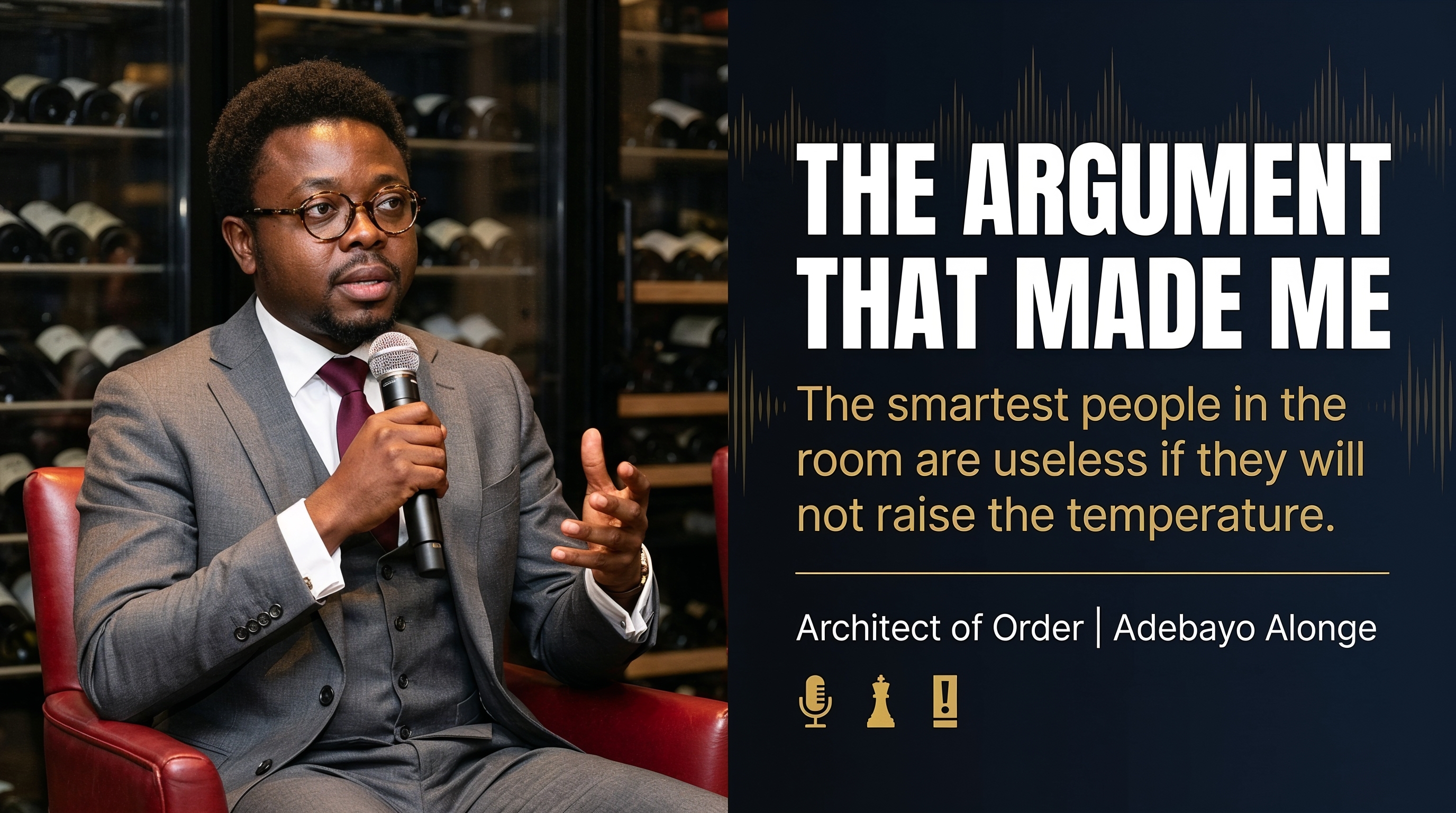
The most important thing Harvard taught me was that the smartest people in the room are useless if they will not raise the temperature.
How to Actually Use an Elite Degree
If you carry one of these credentials — or any credential — here is how to actually make it count:
A. Treat the credential as a key, never as a chair. Walk through the door. Do not sit down. Find the work that scares you and run at it. The credential earned you access. It did not earn you peace.
B. Ask the question nobody else will ask. In every room, there is a question hanging in the air. Most people will not say it. Be the person who does. The first time will cost you. The second time will earn you respect. By the third time, you will be the person they call when they need real answers.
C. Refuse faux humility. Real humility is grounded in service. Faux humility is grounded in fear of other people’s egos. Know the difference. Speak when speaking is the work.
D. Aim the weapon at a problem that matters. Counterfeit medicines kill millions. Capital does not flow to the small businesses that actually employ people. Cold chains break and vaccines spoil. Climate is collapsing. The Post World War 2 geo-political structure is failing and poor people are suffering as conflicts increase. A whole youth generation in Africa is afflicted with thieving gerontocrats. Mass numbers of people are being genocided for their faith and race. Pick one. Build for it. Use the network the credential gave you to fund the fight.
E. Reject the salary trap. A high-paying job is fine. A high-paying job that lets your training rust is a slow burial. Test yourself. If your degree is not pointed at a problem, point it.
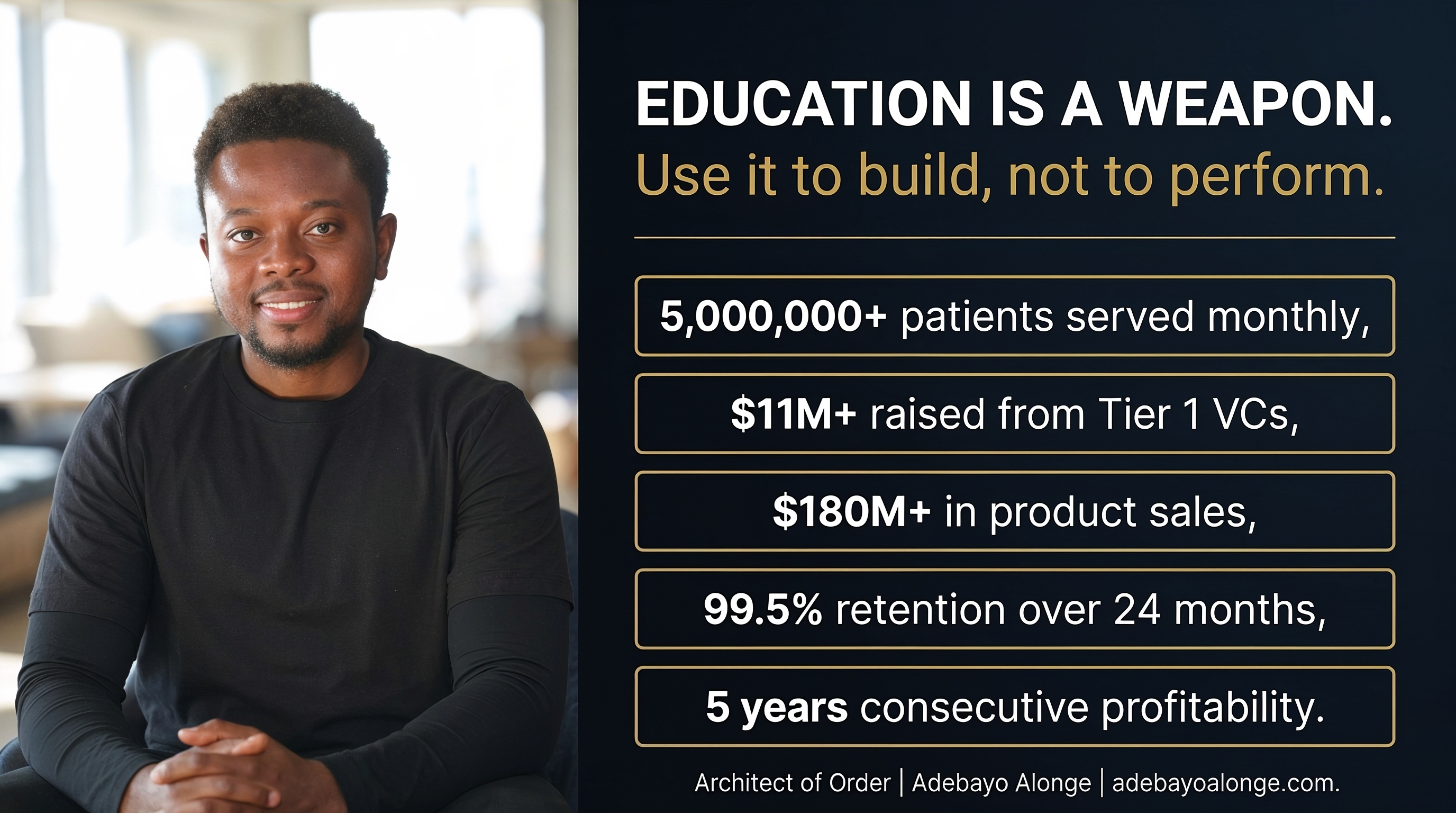
F. Build proof, not posture. Credentials are claims. Companies are evidence. Patients served, capital deployed, vaccines preserved, students taught — these are the only currencies that matter at the end. Five million patients access certified medicines through the platforms my team has built. That number is the only credential that has ever mattered to me.
G. Stay in the arena. The critic is loud. The performer is loud. The builder is busy. Be busy.
What Action Can You Take Today
This week, pick one room you have been comfortable inside.
Ask the question you have been swallowing. Raise the temperature. Watch what happens.
Then write me and tell me what came of it.
Three degrees. One lesson. The lesson is the same one Roosevelt named more than a century ago and that most graduates spend their whole careers avoiding.
The credit belongs to the one in the arena.
Education is a weapon. Use it to build, not to perform.
Onwards.
Adebayo Alonge is the Founder and Group CEO of the RxAll Group. A Harvard Kennedy School Mason Fellow and Cheng Fellow, Yale School of Management alumnus, and MIT Legatum Foundry Fellow, he builds AI-powered platforms that deliver healthcare, capital, and clean energy to underserved markets worldwide. He has raised $11M+ from Tier 1 VCs, driven $180M+ in product sales, and serves 5M+ patients monthly. He is a Fast Company World Changing Ideas 2025 honoree and winner of the Hello Tomorrow DeepTech Prize.
#IvyLeague #HarvardKennedySchool #YaleSOM #MIT #Entrepreneurship
Discover more from Adebayo Alonge
Subscribe to get the latest posts sent to your email.

