Energy is the currency of the universe.” — Richard Feynman
The largest Bitcoin mining companies on earth are liquidating billions of dollars in crypto holdings. They are not panicking. They are pivoting.
MARA Holdings sold over one and a half billion dollars in Bitcoin. Core Scientific converted mining capacity into AI data center hosting. IREN secured a nearly ten billion dollar contract with Microsoft to run AI workloads on infrastructure originally built for blockchain. Hut 8 leased its energy infrastructure in a deal worth almost ten billion dollars.
The pivot is not theoretical. More than seventy billion dollars in cumulative AI and high-performance computing contracts have been announced by former crypto miners. AI revenue is projected to account for seventy percent of combined sector revenue by the end of 2026.
This is not a story about crypto. This is a story about power. Literal power. Electrical, computational, economic.
And it proves a thesis I have been building for years.
AI cannot survive without energy
AI is the most energy-hungry technology ever deployed at scale. Global data center electricity consumption reached approximately four hundred and fifteen terawatt-hours in 2024. By 2026, estimates suggest it will approach one thousand terawatt-hours — equivalent to the fifth-largest energy consumer on earth if data centers were a country.
The demand is growing at twenty-two percent per year. Nothing in the history of industrial electricity has grown this fast. And renewables — solar, wind, battery storage — are the fastest-growing source of supply, projected to meet nearly half of new data center demand by 2030.
Here is what that means in plain terms: you cannot have AI without energy. And the most scalable, cost-competitive energy sources available today are clean.
Climate Tech and AI are Two Sides of Same Coin
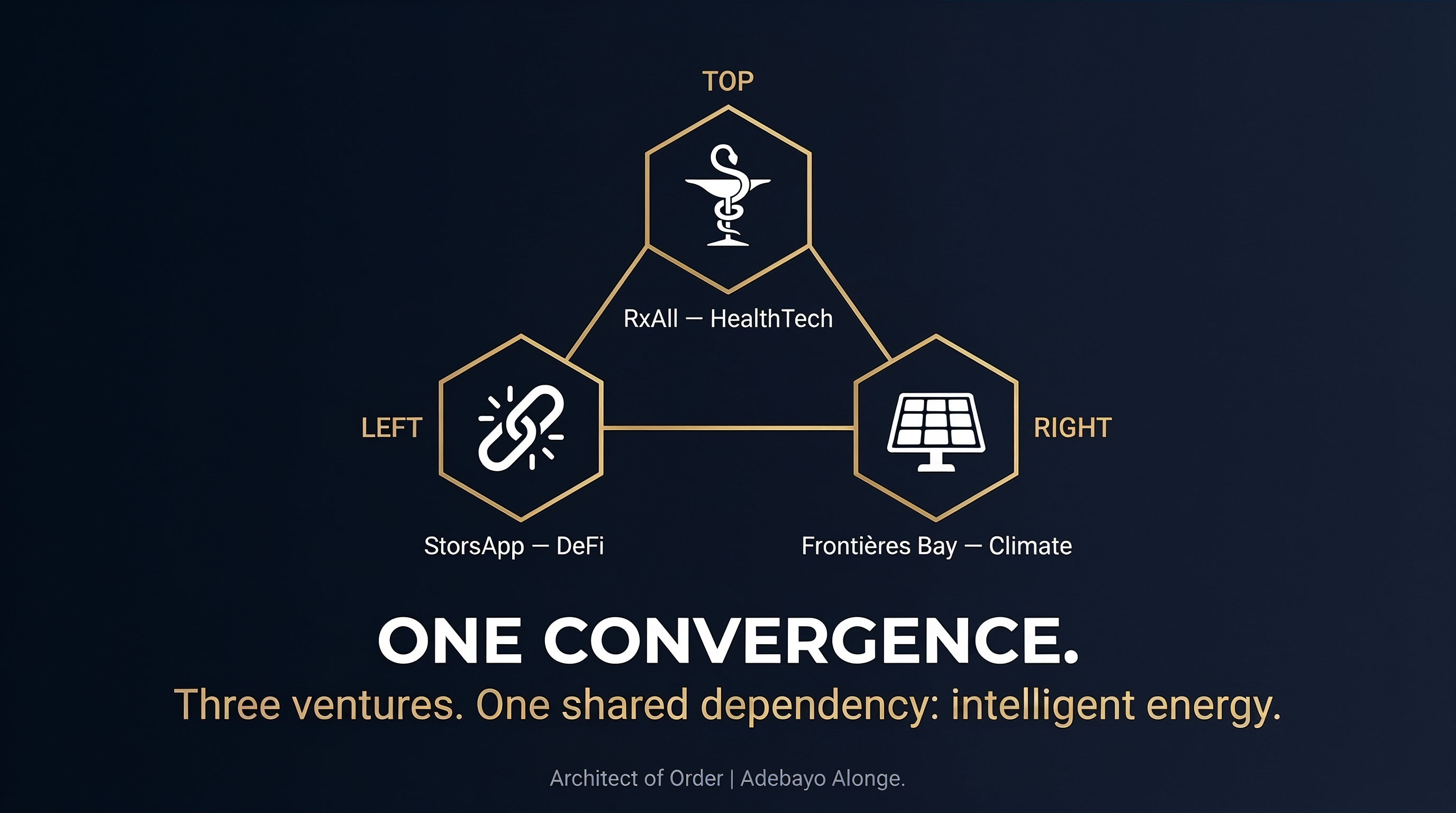
Most people treat climate tech and AI as separate sectors. Climate investors fund solar panels. Tech investors fund foundation models. The two worlds rarely talk.
That separation is a strategic error.
Every climate challenge — optimizing grid loads, predicting energy demand, managing distributed solar networks, reducing cold chain waste, monitoring emissions — is fundamentally a data problem. You cannot manage what you cannot measure. You cannot optimize what you cannot model. You cannot scale what you cannot predict.
AI provides the measurement, the models, and the prediction. Clean energy provides the power to run it.
Climate tech without AI is hardware waiting for a brain. AI without clean energy is intelligence waiting for a power source.
How Can You Benefit From This Trend
A. Recognize the convergence as infrastructure, not ideology. The Bitcoin miners did not pivot because of climate commitments. They pivoted because AI workloads generate three to twenty-five times more revenue per megawatt than mining. The economics made the decision. The same economics apply to every energy-intensive industry on earth.
B. Design AI systems for energy scarcity, not abundance. At RxAll, our AI drug authentication system runs on devices that operate in environments with intermittent power. At StorsApp, our credit engine processes data for businesses that operate off-grid. Every product we build assumes energy constraints as a design parameter. That discipline makes our systems deployable where they are needed most.
C. Build distributed energy infrastructure that enables AI at the edge. At Frontières Bay Energies, we build solar-powered cold chain systems in communities the grid forgot. We do not wait for centralized infrastructure. We deploy intelligence first — AI-optimized energy management, predictive load balancing, real-time monitoring — and the energy network follows.
D. Deploy capital where the convergence creates value. At StorsApp, we have deployed over four million dollars in working capital at twelve percent APY with a zero-loss lending rate. The small businesses we finance — pharmacies, retail shops, agricultural suppliers — are the exact nodes where AI and clean energy converge at the last mile.
E. Stop treating sustainability as a cost center. Sustainability is an operating system. The companies that will dominate the next decade — from crypto miners pivoting to AI data centers, to rural pharmacies running AI-powered cold chains — are the ones that treat clean energy and artificial intelligence as a single integrated infrastructure stack.
What You Can Do Today
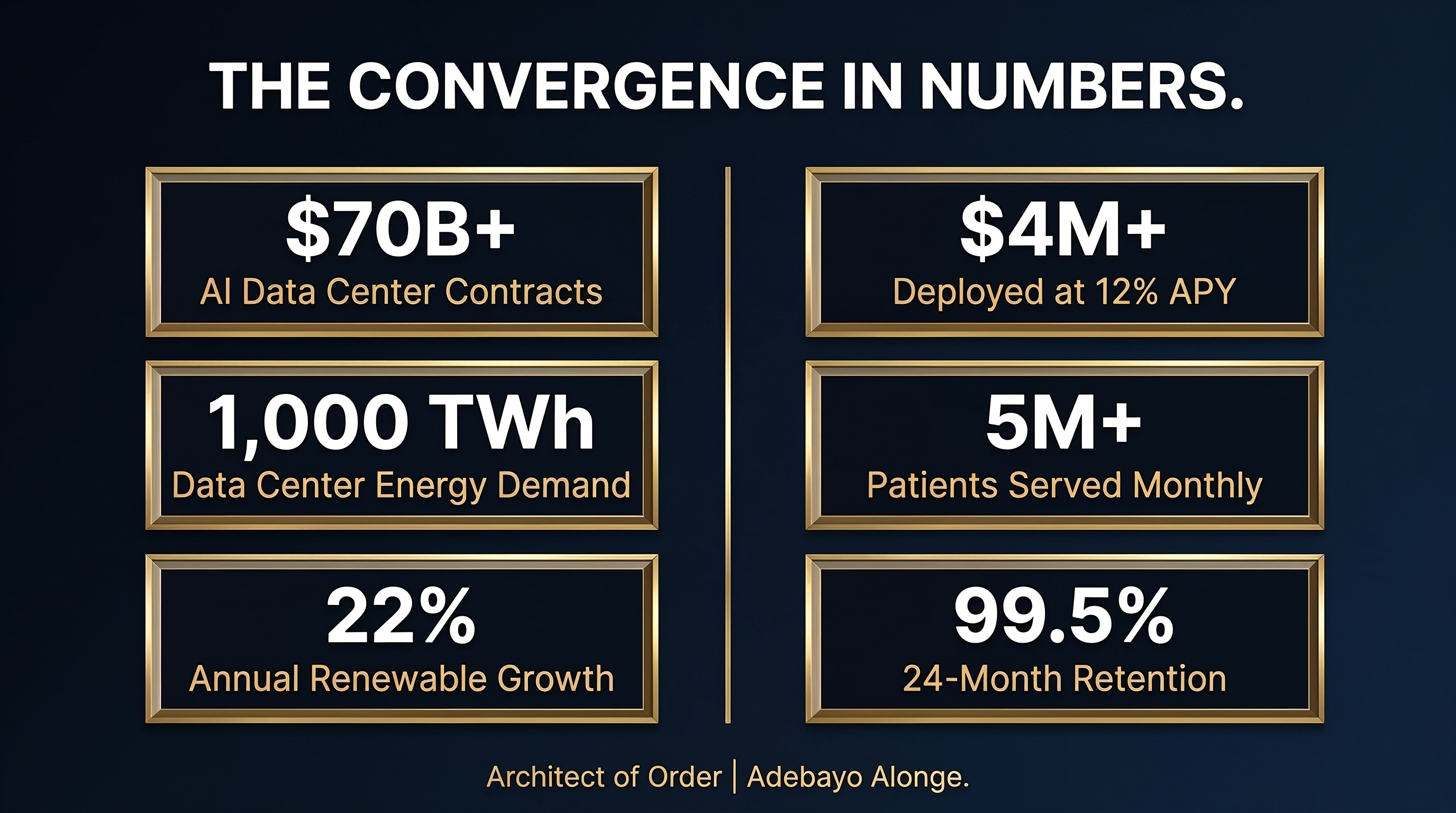
The convergence is already happening. Seventy billion dollars in contracts. One thousand terawatt-hours in demand. Twenty-two percent annual growth in renewable capacity. These are not projections. They are the present.
The question is not whether AI and clean energy will converge. The question is who will build the infrastructure where it is needed most — not in Northern Virginia data corridors, but in the markets where five million patients depend on cold chain integrity, where ten thousand pharmacies need reliable power, where small businesses close because the grid fails.
The future of energy is not centralized. It is distributed, solar-powered, and AI-optimized.
Every climate problem is a data problem. Every data problem is an AI opportunity.
Onwards.
Adebayo Alonge is the Founder and Group CEO of the RxAll Group. A Harvard Kennedy School Mason Fellow, Yale School of Management alumnus, and MIT Legatum Fellow, he builds AI-powered platforms that deliver healthcare, capital, and clean energy to underserved markets worldwide. He has raised $11M+ from Tier 1 VCs, driven $180M+ in product sales, and serves millions of patients monthly. He is a Fast Company World Changing Ideas 2025 honoree and winner of the Hello Tomorrow DeepTech Prize.
Discover more from Adebayo Alonge
Subscribe to get the latest posts sent to your email.

