
“The measure of a society is found in how it treats its weakest and most helpless citizens.” — Jimmy Carter
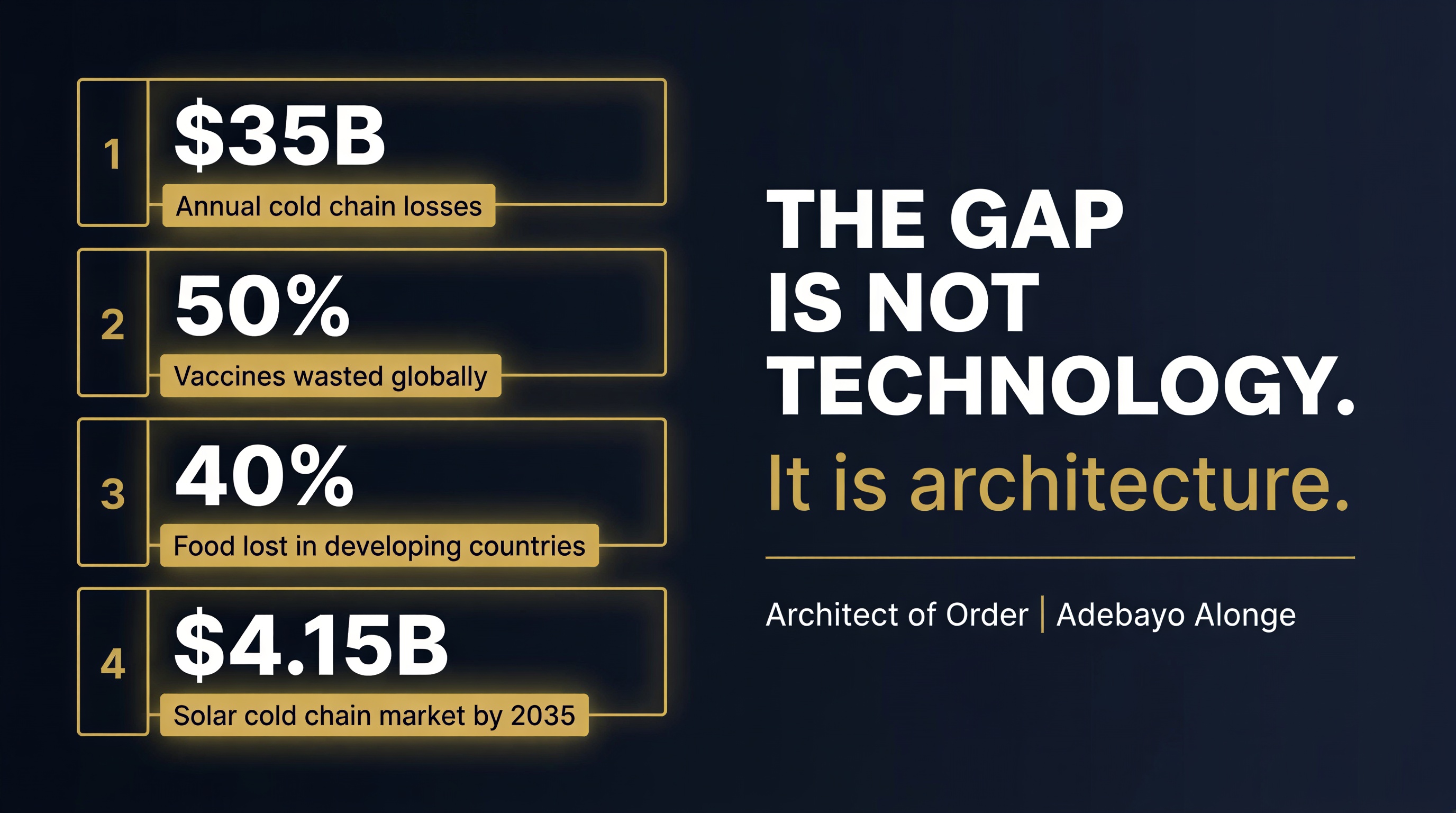
Here is a number that should keep every global health leader awake at night: $35 billion.
That is how much the world loses every year to cold chain failures — vaccines that degrade, biologics that spoil, food that rots between the farm gate and the dinner table. The World Health Organization estimates that up to 50% of vaccines are wasted globally each year, largely because of temperature control failures. In developing countries, food loss before reaching consumers reaches 40%.
These are not rounding errors. These are lives.
A child in rural Senegal does not care about the GDP of the pharmaceutical cold chain logistics market. She cares whether the measles vaccine in the nurse’s hand still works. A farmer in northern Nigeria does not track the $425 billion cold chain industry. He watches his tomatoes rot on the back of a truck because the nearest cold storage facility is 300 kilometers away.
The distance between a vaccine and a vaccinated child is not measured in miles. It is measured in degrees Celsius.
Why does this problem still exist?
The cold chain conversation suffers from a fundamental misdirection. Most of the investment, most of the innovation, and most of the policy attention goes to markets that already have infrastructure. The cold chain logistics market is growing at 12% annually — but that growth is concentrated in North America, Europe, and East Asia. The places where cold chain failures kill the most people receive the least investment.
This is not a technology problem. The technology exists. Solar panels have dropped in cost by over 90% in the last decade. Battery storage has reached levels of efficiency that were unimaginable ten years ago. Insulation engineering has advanced to the point where a solar-powered cold box can maintain temperature within half a degree Celsius for over 42 hours without any solar input.
This is an architecture problem. The systems that decide where cold chain infrastructure gets built, who funds it, and who operates it — those systems are broken. They prioritize markets with existing demand signals over markets with existing need. They chase return on investment in places where the return already exists, and ignore the places where the return would be transformational.
The result is a cold chain gap that mirrors every other infrastructure gap in global health: the people who need it most are the last to get it.
How we solve it:
At Frontières Bay Energies, we are building from the other direction. We start where the grid ends.
A. Design for zero-grid dependency. Our solar-powered cold chain units run entirely on solar energy with battery backup. No diesel generators. No grid connection required. This is not a compromise — it is a design principle. The most reliable energy source in equatorial regions is not the grid. It is the sun.
B. Deploy at the point of need. Traditional cold chain infrastructure is centralized — large warehouses in capital cities, connected by trucking networks to regional hubs. This model fails when the roads are unpaved and the distances are vast. We deploy modular, decentralized cold storage units at the community level — near the farm gate, near the clinic, near the market.
C. Integrate across sectors. A cold chain that only serves vaccines is underutilized nine months of the year. A cold chain that only serves agriculture misses the health opportunity. Our units serve both — vaccines and medicines during immunization campaigns, food and produce during harvest season. Multi-use infrastructure is sustainable infrastructure.
D. Build the business model alongside the technology. The solar cold chain market is projected to grow from $820 million to $4.15 billion over the next decade. But growth requires more than technology — it requires financing models that work for smallholder farmers and rural health systems. We are designing pay-as-you-store models that make cold chain access affordable without subsidy dependency.
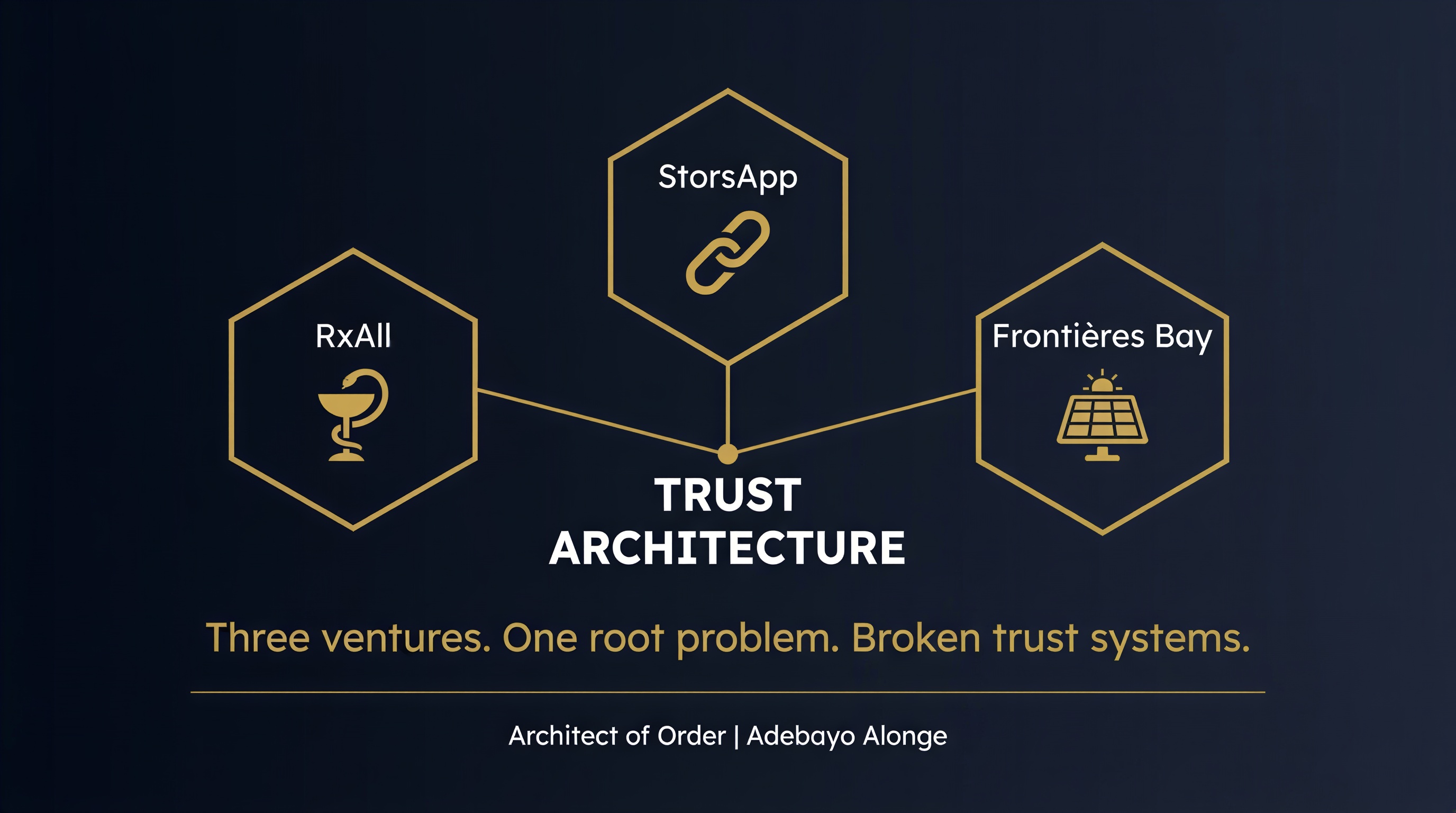
E. Prove it works, then scale it. We do not pitch hypotheticals. We deploy. We measure. We iterate. The same operational discipline that drove RxAll from 40% rejection to 92% adoption and StorsApp to a zero-loss lending rate applies to Frontières Bay. Build trust through results, not promises.
What Can You Do Today?
The world does not need another white paper on vaccine distribution. It needs refrigerators that work where the grid does not. It needs solar panels on clinic rooftops in rural communities. It needs cold storage at the farm gate so a farmer’s harvest reaches the market before it rots.
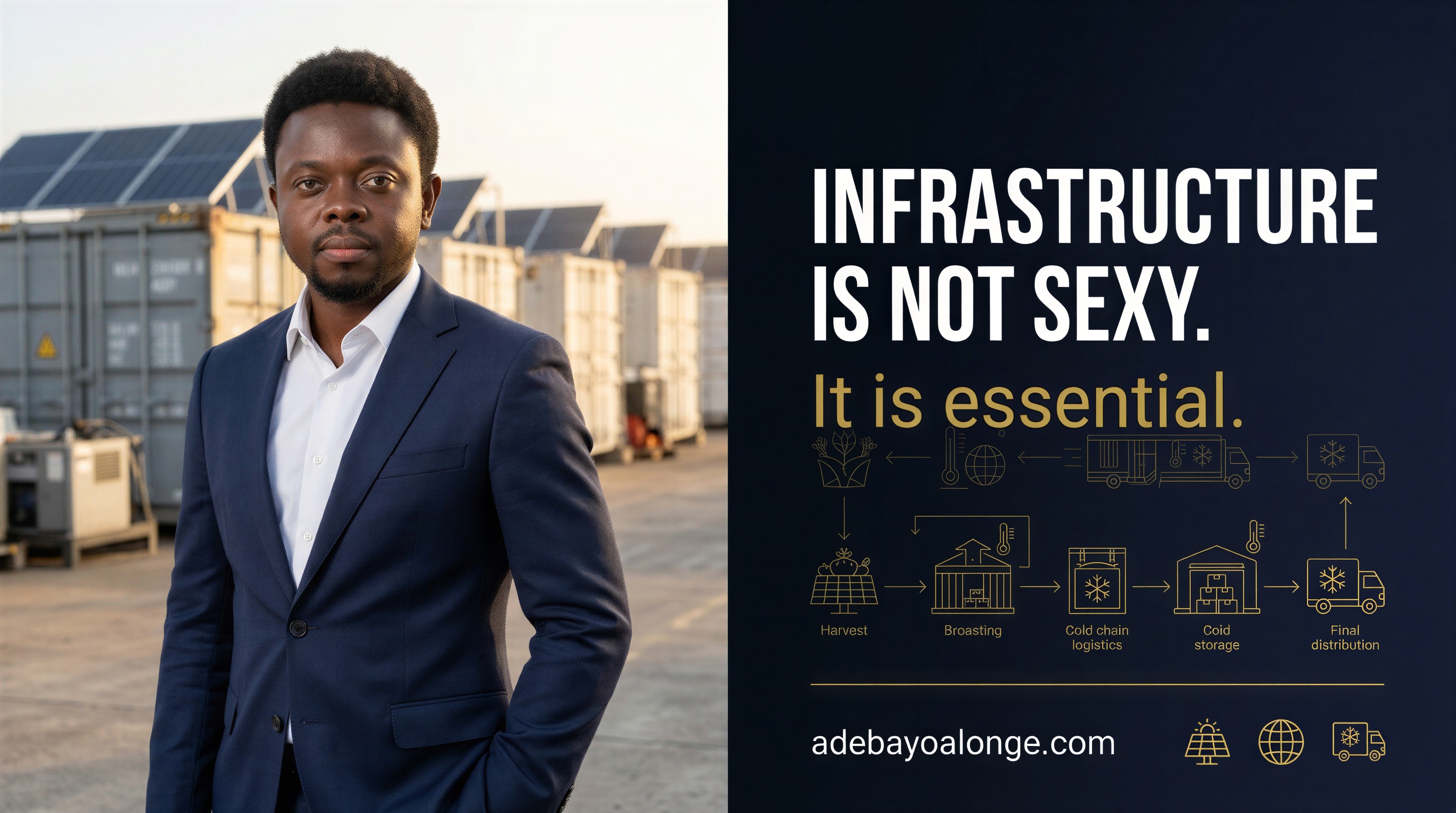
Infrastructure is not sexy. It is essential.
The global health community spends billions on drug development, clinical trials, and last-mile delivery programs. But if the vaccine is dead before it reaches the syringe, none of that spending matters. The cold chain is not a logistics detail. It is the foundation on which every other health intervention rests.
The most important technology in healthcare is not AI. It is a refrigerator that works without the grid.
Onwards.
Adebayo Alonge is the Founder and Group CEO of RxAll Group. A Harvard Kennedy School Mason Fellow, Yale School of Management alumnus, and MIT Legatum Fellow, he builds AI-powered platforms and infrastructure solutions that deliver healthcare, capital, and clean energy to underserved markets worldwide. He has raised $11M+ from Tier 1 VCs, driven $180M+ in product sales, and serves millions of patients monthly. He is a Fast Company World Changing Ideas 2025 honoree and winner of the Hello Tomorrow DeepTech Prize.
#ColdChain #ClimateTech #SolarEnergy #GlobalHealth #DeepTech
Discover more from Adebayo Alonge
Subscribe to get the latest posts sent to your email.

