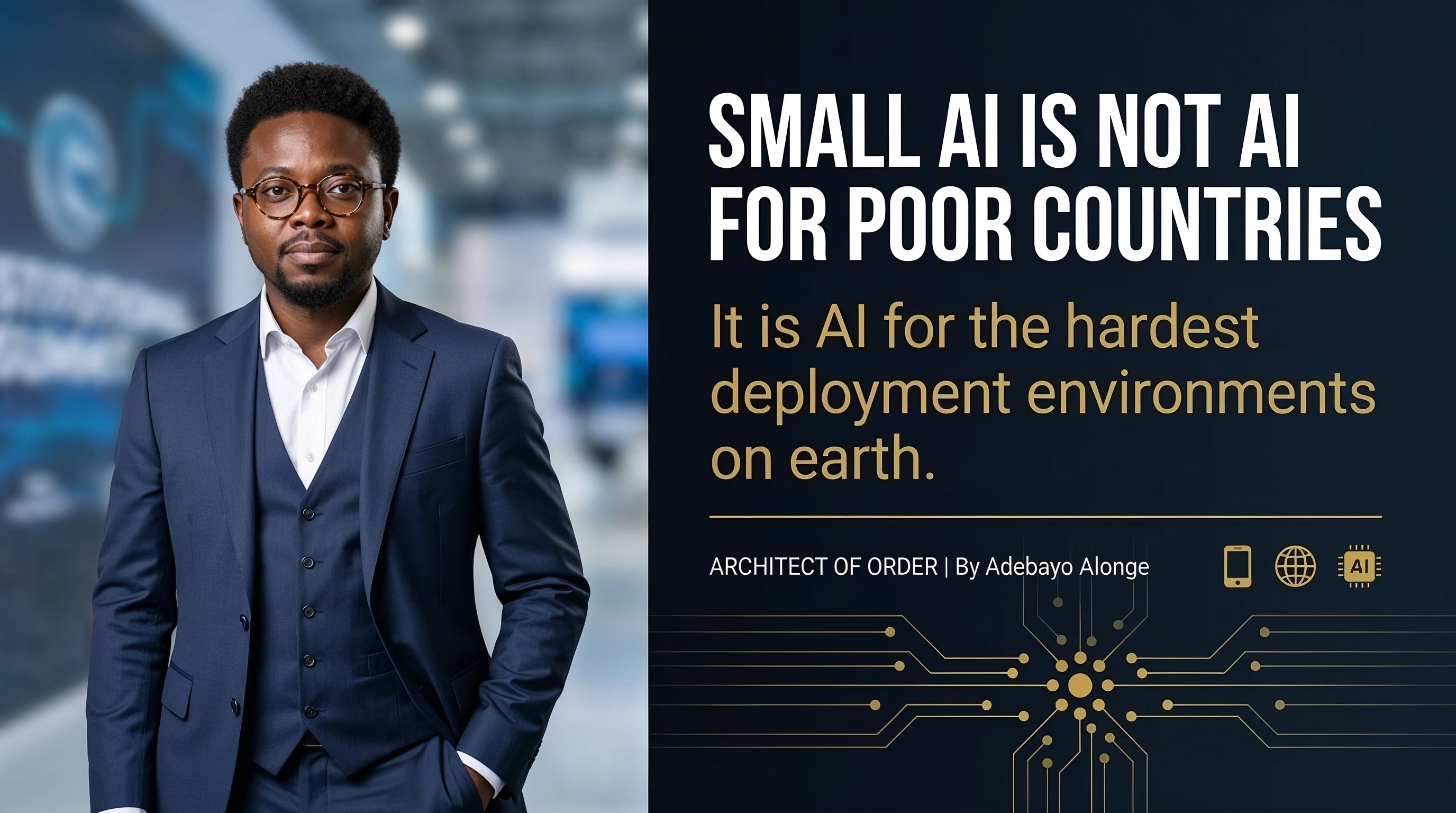
The AI revolution could widen rather than narrow the gap between rich and poor countries.” — World Bank, June 2026
The World Bank issued a warning several days ago that should concern every builder in the AI ecosystem. The poorest countries — the ones most battered by the pandemic, the war in Ukraine, and now the instability in Iran — are least positioned to benefit from AI-driven productivity gains.
This is not surprising. It is predictable. And it is preventable — if the global AI conversation stops worshipping scale and starts respecting precision.
What I have learned building AI Business for the Global South Over 10 Years
I have been building AI systems since 2016. Not large language models. Not chatbots. Not the kind of AI that generates headlines at developer conferences.
I built a handheld molecular sensor paired with a deep learning classification model that tells a pharmacist in twenty seconds whether the medicine on her shelf is authentic or counterfeit. Counterfeit and substandard medicines kill an estimated one million people every year. One hundred thousand of those deaths happen on the African continent alone.
When I started, policymakers in the markets where I operate dismissed AI entirely. They called it a gimmick. They asked why I did not just use normal software. Then in 2022, OpenAI launched ChatGPT, and suddenly every government official on earth decided AI was real.
But they decided it was real because a chatbot wrote a sonnet — not because a classification model was authenticating medicines for millions of patients. And that misunderstanding now shapes how billions of dollars in AI investment are allocated.
Scale distorts the AI conversation
The global AI conversation is distorted by scale.
The assumption: bigger models, bigger compute, bigger investment equals more impact. For some applications — frontier foundation models, general-purpose reasoning, multimodal systems — this is true. But for the applications that matter most to the largest number of people on earth, it is not.
Over 2.2 billion people remain offline globally. Less than one percent of ChatGPT usage comes from low-income countries. Africa holds less than one percent of global data center infrastructure. The AI revolution, as currently architected, is built for the richest fifth of the world.
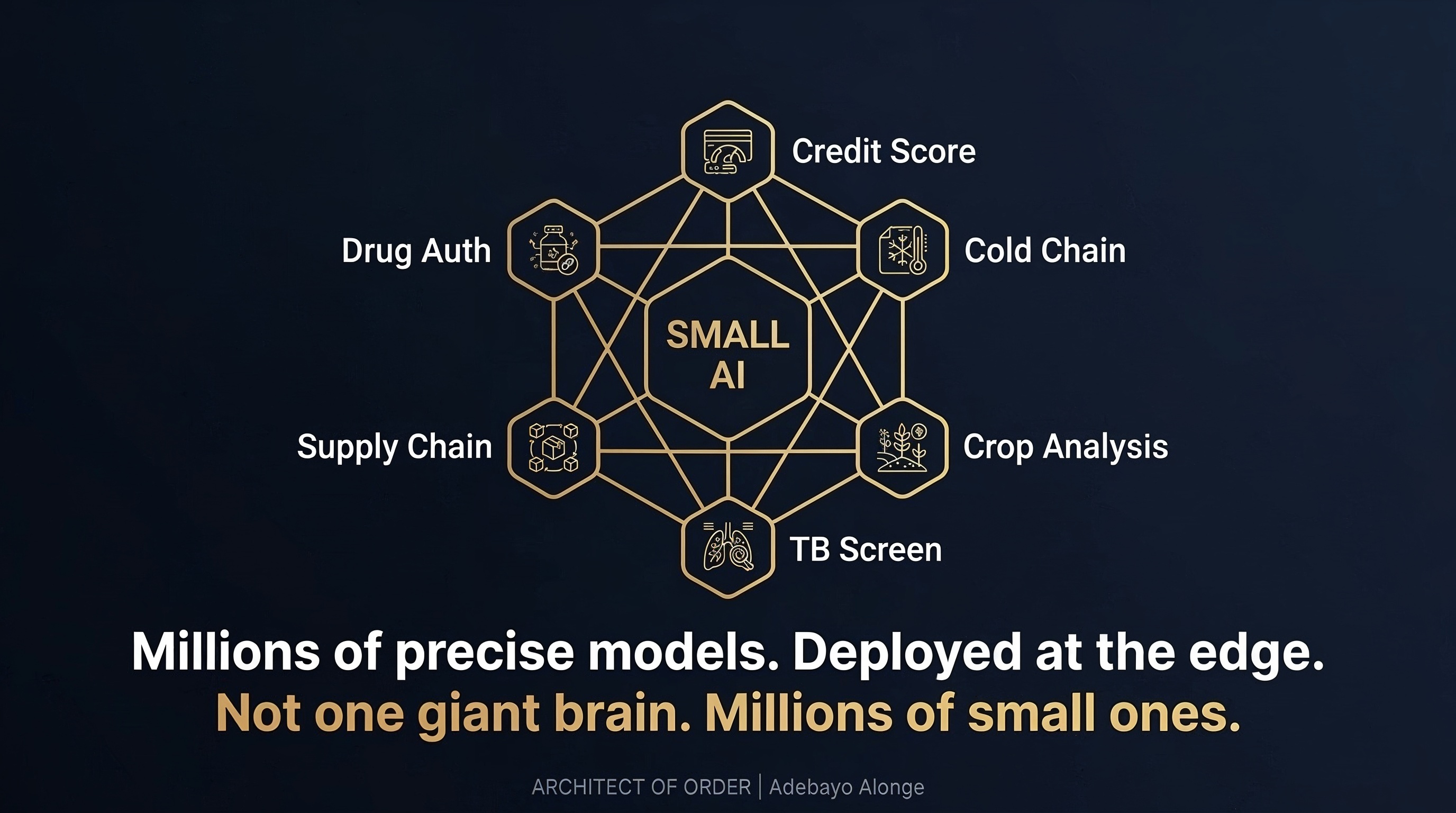
The World Bank has responded with a concept it calls “small AI” — practical, affordable AI solutions designed to run on everyday devices in environments with limited connectivity, limited power, and limited technical capacity. Crop disease classifiers on a farmer’s phone. Tuberculosis screeners in a clinic without broadband. Drug authentication systems that work when the electricity goes out.
The concept is correct. But the framing is dangerous.
How to make ‘Small AI’ work for those who need it
A. Stop equating “small” with “simple.” When my team compressed our drug authentication model for edge deployment on Android, the engineering challenge was harder — not easier — than the cloud version. You cannot indiscriminately reduce parameters. You must identify which parameters matter for that specific use case, that specific user, that specific environment. Context-aware compression demands more engineering discipline than cloud deployment, not less.
B. Fund accordingly. The World Bank and development agencies must stop assuming that because the AI is small, the investment required is small. I have watched grant-makers hear “small AI” and conclude that a company should be able to build it for five hundred thousand dollars. That is not how engineering works. Smaller deployment does not mean cheaper development. The research, training data collection, model optimization, and hardware integration are capital-intensive regardless of the deployment footprint.
C. Reject the geographic frame. Small AI is not “AI for developing countries.” The engineering lessons transfer everywhere. Rural healthcare in North America faces the same constraints we navigate in West Africa — limited broadband, unreliable power, users who need answers without waiting for a cloud round trip. Military field deployments, disaster response, off-grid industrial operations — all of them need small, precise, edge-deployable AI. The solutions we build for the hardest environments are the ones the rest of the world will eventually need.
D. Educate policymakers beyond LLMs. Most government officials now equate AI with large language models. That is like equating transportation with commercial aviation — technically a subset, but it ignores the buses, bicycles, and freight trains that move most of the world. Deep learning classification models, computer vision systems, spectroscopy-based authentication, and predictive analytics are all AI. Policymakers who only see LLMs will only fund LLM infrastructure and miss the small AI applications already saving lives.
E. Invest in the ecosystem, not just the model. The AI model is thirty percent of the problem. The other seventy percent is the ecosystem — reliable power for devices, periodic connectivity for model updates, trained operators who understand the workflow, and regulatory environments that do not confuse data security with data paranoia. I have worked with governments that demanded we disable all cloud syncing and remove any ability to update the model remotely. That kind of paranoia does not protect sovereignty. It freezes the technology at the moment of installation and guarantees obsolescence.
F. Measure impact differently. The success metric for frontier AI is benchmark scores and revenue. The success metric for small AI is lives saved, businesses served, and systems made trustworthy. If funders only invest in what performs well at demo day, they will miss the AI that changes the world at the point of care.
The Future of AI is ‘Small AI’
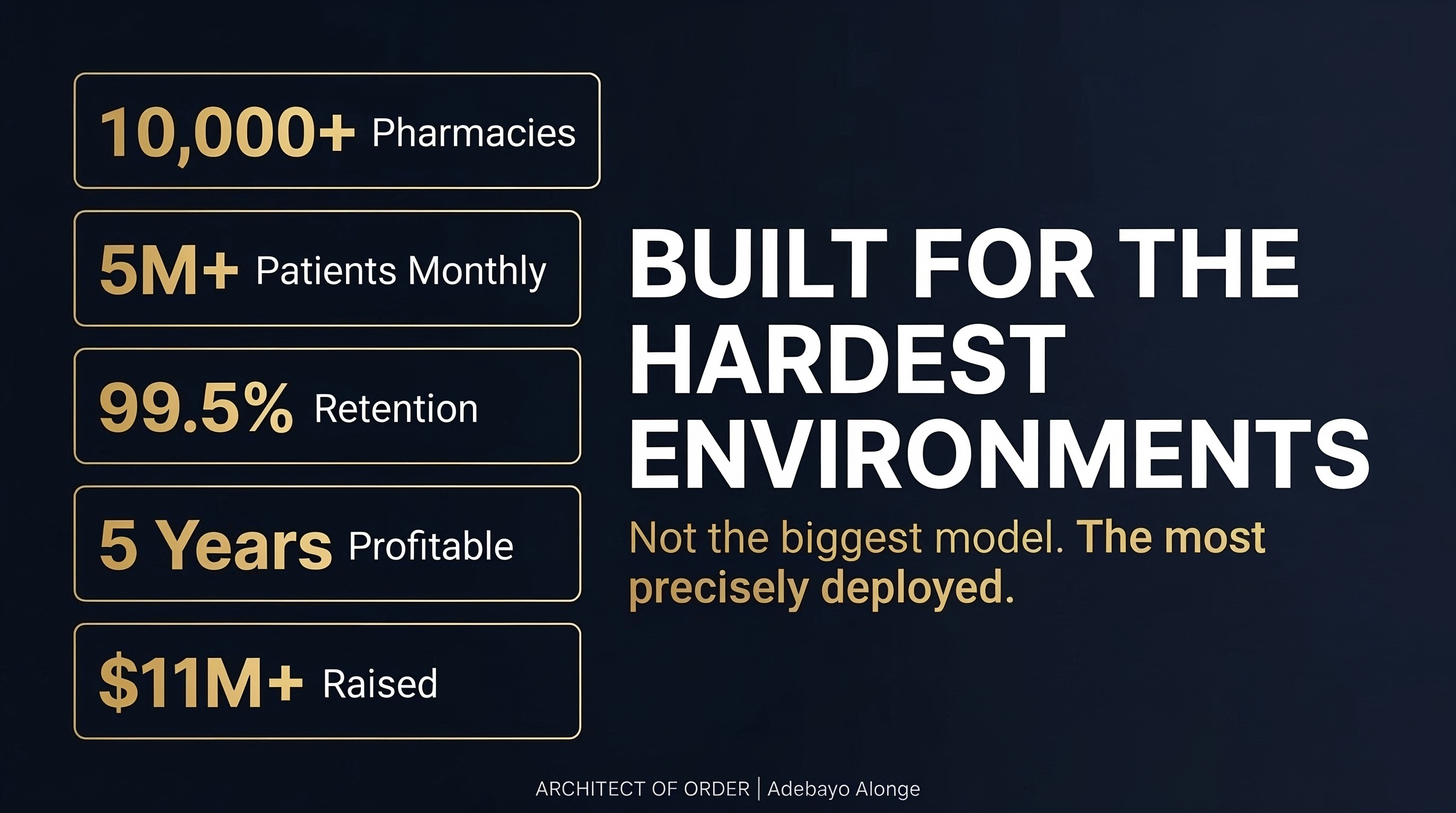
At RxAll, we have deployed AI for drug authentication, credit scoring, and cold chain monitoring. Our platform serves over ten thousand pharmacies, reaches more than five million patients monthly, and maintains a 99.5 percent retention rate. We have been profitable for five consecutive years. We raised over eleven million dollars from Tier 1 VCs — not by building the biggest model, but by building the most precisely deployed one.
The future of AI is not one giant brain in a data center. It is millions of small, precise models deployed at the edge — each one solving a specific problem in a specific context.
Small AI is not AI for poor countries. It is AI for the hardest deployment environments on earth. And the builders who master it will shape the next decade of technology — not from Silicon Valley, but from the places where precision is survival.
Onwards.
Adebayo Alonge is the Founder and Group CEO of RxAll, StorsApp, and Frontières Bay Energies. A Harvard Kennedy School Mason Fellow, Yale School of Management alumnus, and MIT Legatum Fellow, he builds AI-powered platforms that deliver healthcare, capital, and clean energy to underserved markets worldwide. He has raised $11M+ from Tier 1 VCs, driven $180M+ in product sales, and serves millions of patients monthly. He is a Fast Company World Changing Ideas 2025 honoree and winner of the Hello Tomorrow DeepTech Prize.
Discover more from Adebayo Alonge
Subscribe to get the latest posts sent to your email.

