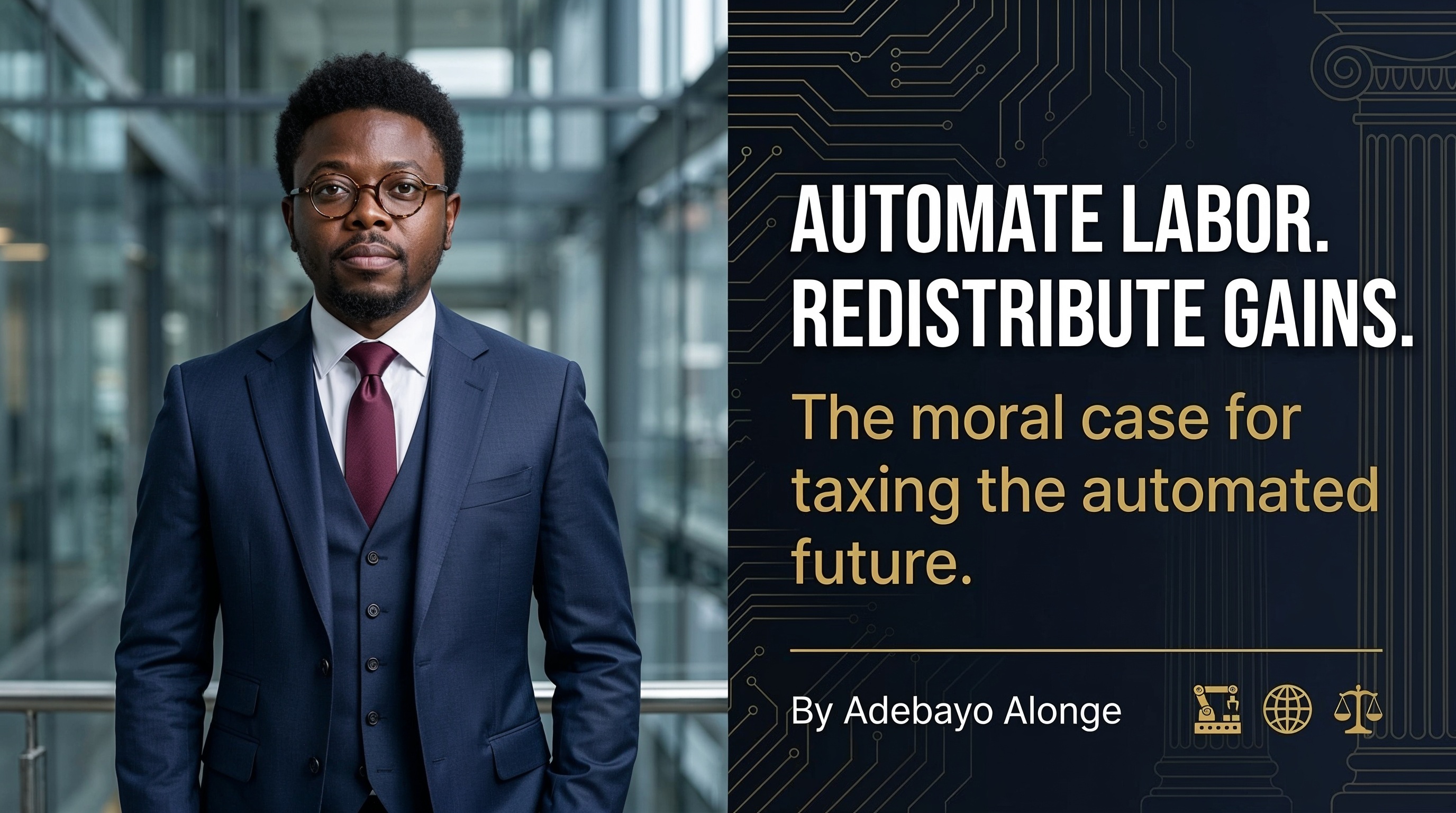
Aristotle warned that if every tool could perform its own work on command, neither would the master need servants. We are building those tools. And we are not preparing for what comes after.
A Seventeen-Year-Old’s Calculus
I spoke recently with a high school junior. Not a disengaged kid scrolling through distractions. A clear-eyed young man who had run the numbers on his own future and decided the traditional path was a losing bet.
Two hundred thousand dollars in student loans. A saturated white-collar market. AI tools that can draft contracts, analyze data, write code, and manage projects — faster and cheaper than any new graduate.
His conclusion: skip college. Learn a trade. Become a plumber or an electrician. Build a life with his hands in a world that no longer values what his degree would teach his mind.
He is seventeen. And his logic is airtight.
That is the most alarming sentence I have written in months.
The Automation Freight Train Has No Brakes
The data confirms what this teenager already understands.
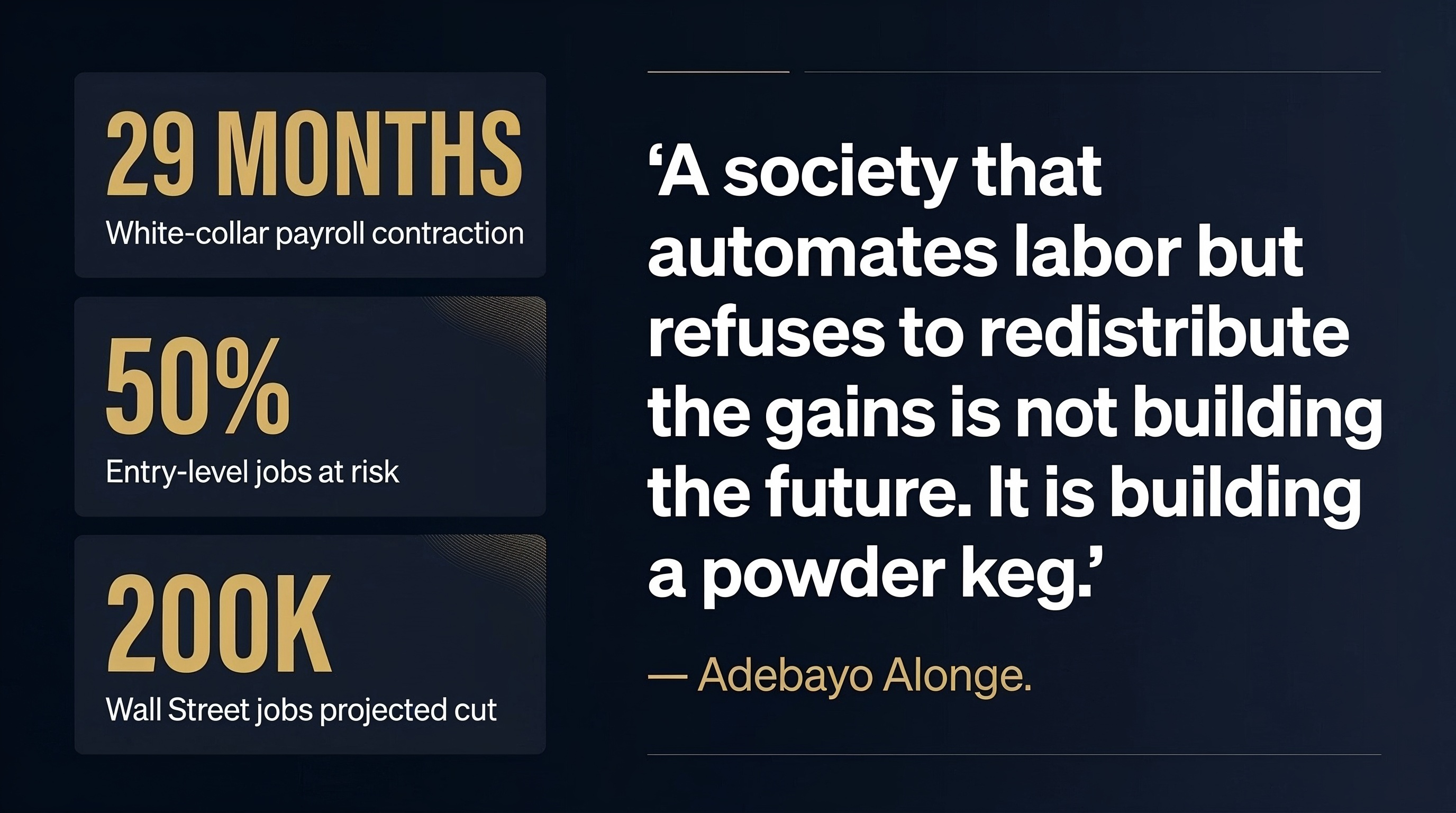
White-collar payrolls in the United States have contracted for twenty-nine consecutive months — unprecedented outside a formal recession. Anthropic’s CEO has warned that AI could eliminate half of all entry-level white-collar jobs within five years. OpenAI has published a policy paper proposing robot taxes, public wealth funds, and automatic safety-net triggers. One in six employers plan AI-driven headcount reductions this year. Wall Street banks project removing two hundred thousand jobs in the next three to five years — primarily entry-level and back-office roles.
The displacement is not hypothetical. It is measurable. It contributed to four and a half percent of total job losses in 2025 alone. And the pace is accelerating.
The people building these systems know exactly what is coming. They are telling us. OpenAI’s CEO compares this moment to the Progressive Era and the New Deal. Anthropic’s CEO has called for billionaires to support higher taxes on AI wealth. Even venture capitalists are proposing to eliminate income taxes for earners under one hundred thousand dollars — funded by taxing capital and automated labor.
The architects of automation are designing the future. The question is who pays for the transition.
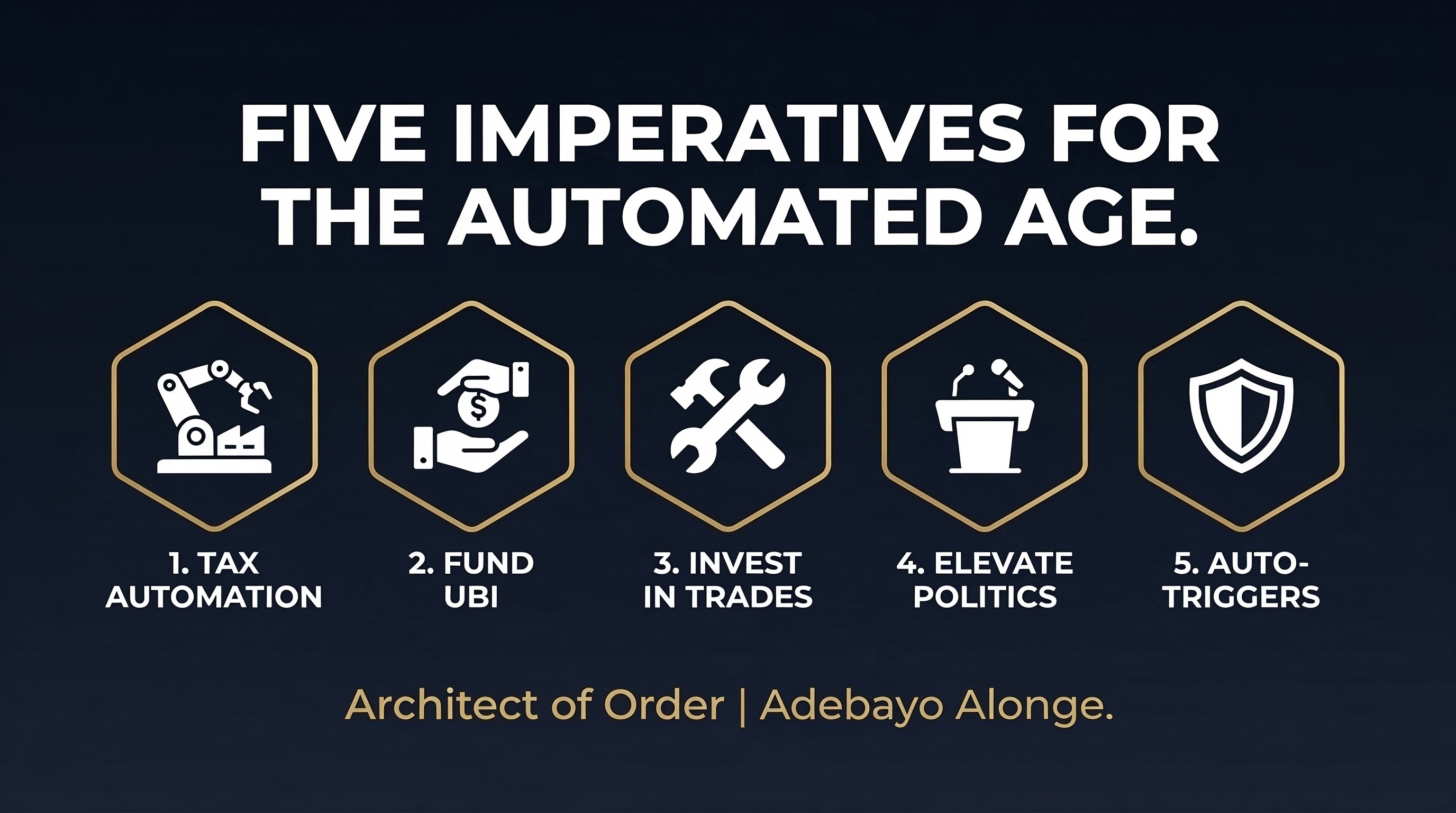
Five Solutions for the Automated Age
A. Tax automated labor at the source. If a company replaces five thousand workers with AI agents, it should pay into the system what those workers would have funded through payroll taxes. The current tax code penalizes hiring and subsidizes automation. Reverse it.
B. Fund universal income infrastructure — now. Not as a pilot. Not as a study. As policy. The gains from automation are real and measurable. A public wealth fund — seeded by AI companies, invested in diversified assets, distributed to citizens — gives every person a stake in the technology reshaping their world.
C. Invest massively in trades and care work. The jobs AI cannot replace are physical, relational, and human. Plumbing. Electrical work. Eldercare. Childcare. These are not fallback careers. They are the foundation of a functional society. Fund them accordingly.
D. Make politics a prestige career for young people. The policies governing AI will shape civilization for the next century. We cannot afford to leave those decisions to legislators who do not understand the technology — or to lobbyists who do. Young people must enter politics not as a last resort but as a first calling.
E. Build automatic safety-net triggers. When AI-related displacement crosses defined thresholds, expanded benefits — income support, wage insurance, retraining funds — should activate without requiring new legislation. Design the system to respond at the speed of the disruption.
This is a Moral Argument. Not Anti-Billionaire. But Pro-Civilization.
I am not anti-billionaire. I believe in markets. I believe in the power of competition to drive innovation. I believe anyone who builds extraordinary value in a free economy deserves extraordinary reward.
But I also grew up in a country where wealth concentrated at the top without redistribution at the bottom. I have seen what happens when the gap between the gated compound and the open street grows too wide. Robberies. Violence. Kidnappings for ransom. Children and women who cannot walk safely in the streets in broad daylight. Terrorism in the name of religion. Instability measured not in percentage points but in lives lost.
The West does not have to learn this lesson the hard way. But it will — unless the people building the automated future also fund the systems that keep society intact during the transition.
This is not socialism. It is survival math. It is the recognition that an economy that produces trillionaires and a permanent underclass in the same decade is not an economy. It is a countdown. And I love and respect trillionaires – don’t get me wrong!
What can we do today?
The billionaires see the future with perfect clarity. They are building it, funding it, and profiting from it. The question is not whether automation will transform the economy. The question is whether the rest of us will have a seat at the table — or be served as the meal.
Support policymakers who understand AI.
Enter politics if you are young and capable.
Build skills in domains AI cannot automate.
And demand — loudly, persistently, without apology — that the companies automating your work fund the society that sustains their customers.
A society that automates labor but refuses to redistribute the gains is not building the future. It is building a powder keg.
Onwards.
Adebayo Alonge is the Founder and Group CEO of RxAll, StorsApp, and Frontières Bay Energies. A Harvard Kennedy School Mason Fellow, Yale School of Management alumnus, and MIT Legatum Fellow, he builds AI-powered platforms that deliver healthcare, capital, and clean energy to underserved markets worldwide. He has raised $11M+ from Tier 1 VCs, driven $180M+ in product sales, and serves millions of patients monthly. He is a Fast Company World Changing Ideas 2025 honoree and winner of the Hello Tomorrow DeepTech Prize.
#AIGovernance #TaxPolicy #FutureOfWork #DeepTech #MoralClarity
Discover more from Adebayo Alonge
Subscribe to get the latest posts sent to your email.

