Peter Drucker once said, “There is nothing so useless as doing efficiently that which should not be done at all.”
I have watched founders spend nine months chasing a single term sheet. I have seen brilliant operators pause their businesses — pause revenue, pause hiring, pause product — to sit in investor lobbies and rehearse pitch decks for people who were never going to write a check.
I decided early that I would never be one of them.
Over the last decade, I have raised more than eleven million dollars from Tier 1 VCs across three ventures — RxAll, StorsApp, and Frontières Bay Energies. I did it while running operations, shipping product, serving over five million patients monthly, and maintaining ninety-nine point five percent retention for twenty-four consecutive months. I did not stop. I did not beg. And I did not lose my mind.
Here is the operating manual.
As A Founder, You now have more funding options
The fundraising industry has changed. When I started, the options were narrow — angel investors, a handful of VC firms, and your own savings. Today the landscape is unrecognizable. Republic and Wefunder have democratized equity crowdfunding. GoFundMe has normalized public capital campaigns. Tokenization in the crypto space lets you fractionalize ownership and raise from a global pool. Platforms like Metal.so automate the prospecting process for warm and cold investor outreach. The tools exist. The problem is not access to capital. The problem is discipline.
3 Fundraising Mistakes Many Founders Make
Most founders make three mistakes. First, they treat fundraising as a season instead of a function. They stop everything else to “do a raise” as if capital formation is a one-time event. It is not. It is a permanent line item in your operating calendar. Second, they rely on cold outreach alone when the data is clear: warm introductions close at five to ten times the rate. Third, they do not know when to walk away. They sit through months of due diligence that goes nowhere, mistaking investor curiosity for investor commitment. If the due diligence is long and painful, it is not for you.
People raise billions today without even a finished product. Sam Bankman-Fried raised billions while gaming during investor call. I am not recommending fraud. I am telling you that urgency and conviction close deals, not perfection and patience. If an investor does not say yes and instead asks for this and that and one more revision, that investor is not your investor. Walk.
How to fundraise like a Pro
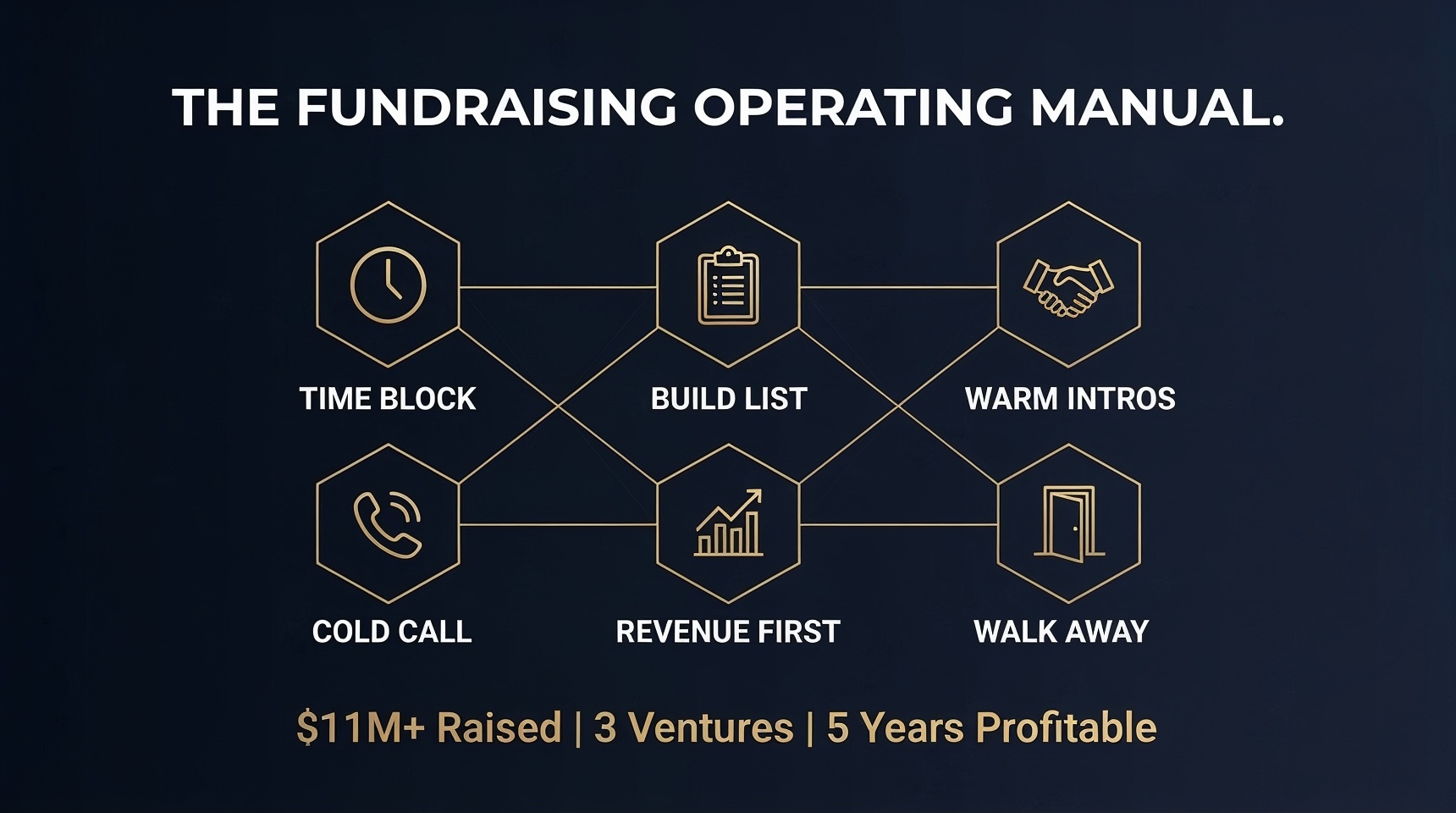
A. Block your time like a surgeon. Mornings are for fundraising — calls, follow-ups, pitch prep. Afternoons are for operations and admin. Do not blend these blocks. The mental switching cost between “sell the vision” mode and “run the business” mode is enormous. Protect each window.
B. Build the master list before you need it. Create a comprehensive roster of every fund, family office, and institutional investor active in your sector and geography. Use Metal.so, Crunchbase, PitchBook, and LinkedIn Sales Navigator to automate the research. Update it monthly. This is infrastructure, not busywork.
C. Mine your warm network first. Every investor you already know is a potential bridge to the investor you need. Ask for introductions. Be specific about who you want to meet and why. Then — and this is critical — cold-call everyone else. Do not wait for permission. Pick up the phone.
D. Let the customer be your best investor. Revenue is the most persuasive pitch deck ever written. Five years of consecutive profitability. One hundred and eighty million dollars in product sales. Ten thousand pharmacies on our platform. Those numbers did more for our fundraising than any slide deck. Keep serving your customers. Keep building retention. When the revenue is real, debt instruments open up from banks and finance houses. Equity investors start competing for allocation.
E. Know every modern vehicle. Crowdfunding platforms like Republic for community rounds. Tokenization for fractional global ownership. Revenue-based financing for growth without dilution. Convertible notes for speed. SAFE notes for simplicity. The menu is longer today than it has ever been. Learn every option.
F. Learn when to walk away. Desperation is the most expensive currency in fundraising. If you are chasing, you have already lost leverage. The moment an investor makes the process painful — endless requests, shifting goalposts, “just one more thing” — leave the table. There is always another table. My Taiwanese friend said they have a saying “many birds in the sky, not one decides if I go hungry today”. You have more options that you allow yourself.
G. Understand your real reason for raising. If I fundraise today, it is primarily to get my early backers an exit. My businesses are more than profitable. The capital is a reward for those who believed early — not a lifeline for the company. When you raise from a position of strength, every term sheet looks different.

Do this today.
Block tomorrow morning for fundraising. Build your list this week. Reach out to five warm contacts before Friday. And above all, keep serving the customer who is already paying you.
Your best investor is a paying customer. Everyone else is a bonus.
Onwards.
Author Bio: Adebayo Alonge is the Founder & Group CEO of RxAll, StorsApp, and Frontières Bay Energies. A Harvard Kennedy School Mason Fellow, Yale School of Management and MIT Legatum Fellow alumnus, Adebayo has raised $11M+ from Tier 1 VCs, driven $180M+ in product sales, and serves 5M+ patients monthly across 10,000+ pharmacies. Recognized by Fast Company World Changing Ideas 2025, Hello Tomorrow DeepTech Prize, and Inc. Female 500 Founders 2025.
#Fundraising #DeepTech #StartupCapital #AIHealthTech #ArchitectOfOrder
Discover more from Adebayo Alonge
Subscribe to get the latest posts sent to your email.

