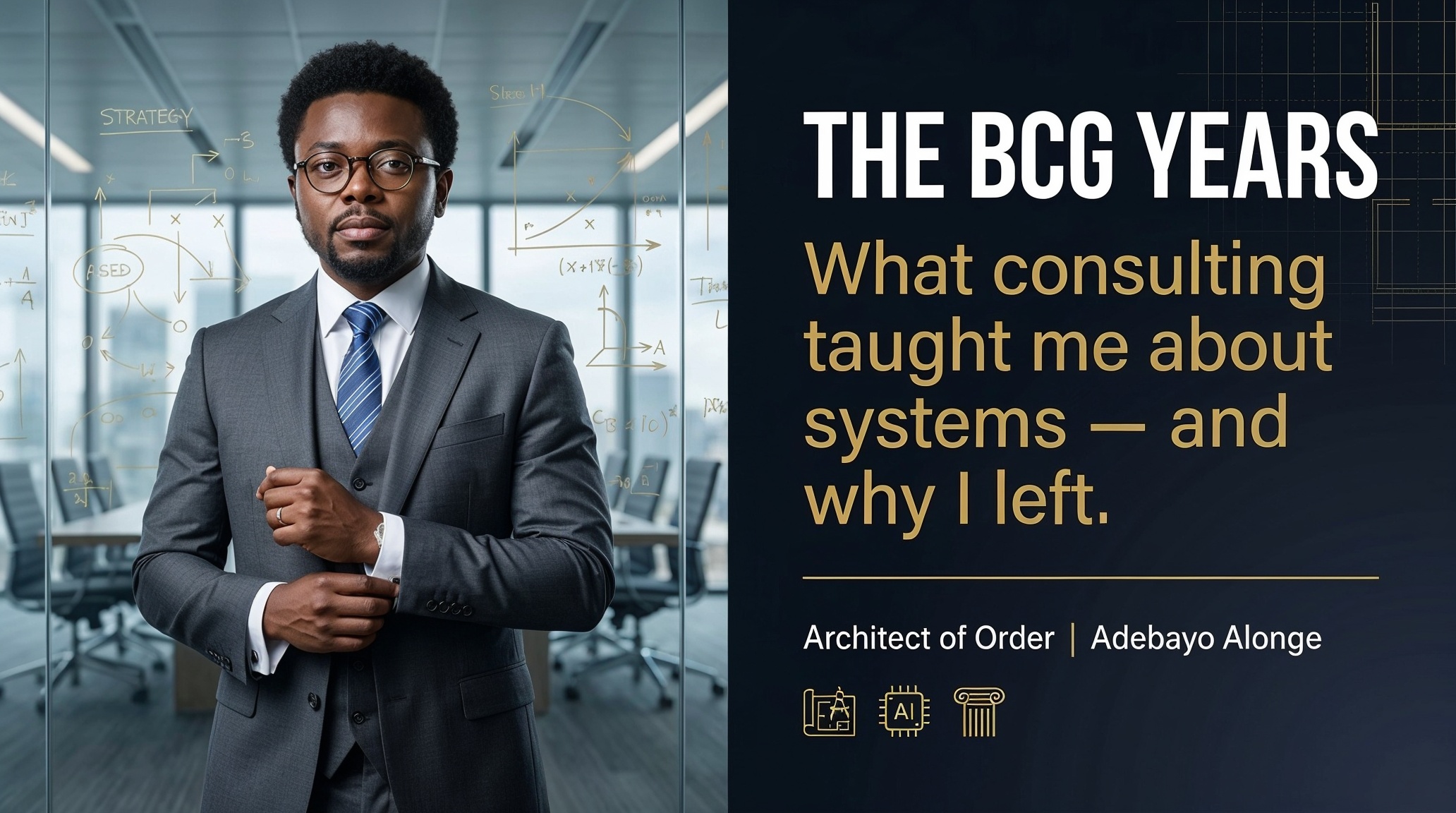
There is nothing so useless as doing efficiently that which should not be done at all.” — Peter Drucker
A decade ago, I held three job offers in my hands.
One came from a top consulting firm in Boston. One came from a quant fund in New York. The third came from BCG — an invitation to help pioneer the firm’s first office in Sub-Saharan Africa, in Lagos.
I said no to New York. I said no to Boston. I chose the hardest market available to me. I believed then, as I believe now, that the fastest path to prosperity runs through the systems that shape it. I wanted to work inside those systems. I wanted to see how power actually moves.
Consulting gave me that education. It also gave me the reason to leave.
The Education
My projects were not small.
I ran turnaround management for a private-sector-led economic think tank. I led a revenue strategy redesign for a major port authority — work that identified up to $500 million in new revenue levers. I built a route-to-market strategy for an industrial goods multinational across two countries, mapping more than 10,000 new points of sale and over $100 million in additional revenue potential.
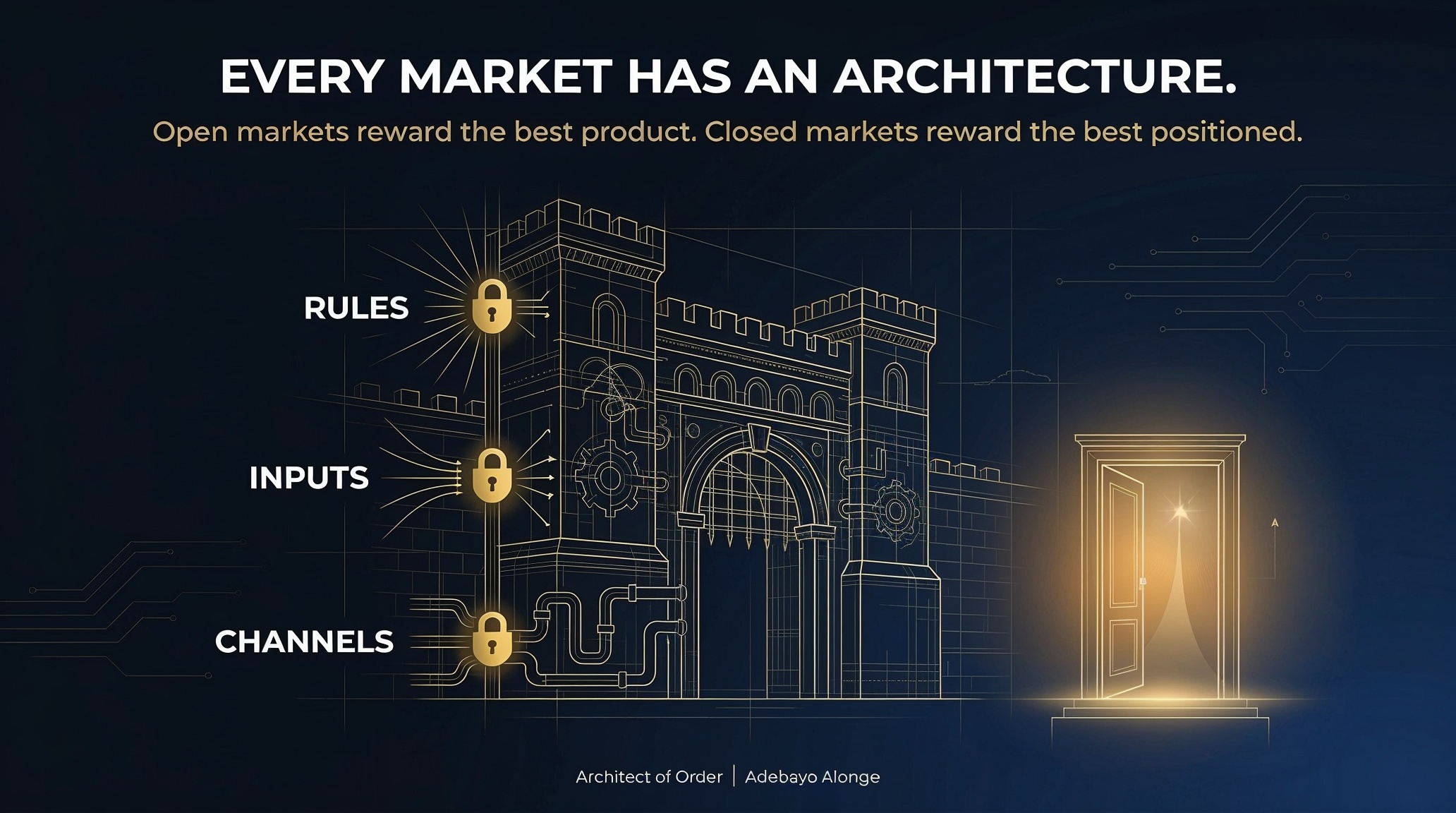
Consulting compresses a decade of pattern recognition into two years. You learn to read a market the way an architect reads a blueprint. You learn that every industry has an architecture — regulation, distribution, capital, political access — and that the architecture decides who wins before anyone competes.
Most people study companies. Consultants study systems.
The Project That Broke the Spell
Then came the engagement that changed my life.
A multinational client wanted to know how to compete against a dominant incumbent in a heavy-industry market. I spent months inside the data and then speaking with distrubutors in the markets. The conclusion was brutal and honest: the market was closed. The incumbent did not merely have scale. It had the architecture itself arranged in its favor — the rules, the inputs, the channels, the relationships.
My best strategic advice, the correct advice, was this: do not challenge the leader. Follow the leader.
The advice was right. And it broke something in me.
Because a closed market is not a business problem. It is a moral problem wearing a business suit. When the architecture of a market is rigged toward incumbency, the price is not paid by the challenger brand. The price is paid by the people at the bottom — the small business owner who cannot enter, the family that pays monopoly prices, the patient who cannot afford the medicine.
And here is what comfortable people miss: closed markets are not an emerging-market disease. They are a global one. US industry concentration rose roughly 50 percent between 2005 and 2020. The American startup rate fell from 13.7 percent in 1978 to 8.4 percent in 2020 — a decline of more than a third. The doors are closing everywhere. Only the speed differs.
Consulting taught me to diagnose that disease with precision. It never let me treat it.
Five Lessons I Took From Consulting Into Building
A. Read the architecture before you enter. Every market is either open or closed. Study the regulation, the distribution, the capital access, and the political exposure before you write a single line of code. Why: the architecture decides your ceiling. First step: map who controls the three chokepoints — rules, inputs, channels.
B. Respect the incumbent’s math. If the system is arranged in the leader’s favor, do not fight the leader on the leader’s field. Why: courage without positioning is just expensive noise. First step: list every advantage the incumbent holds that money alone cannot buy.
C. Build where the system is absent, not where it is strongest. The biggest opportunities are not inside closed markets. They sit in the spaces the system abandoned — unserved patients, unbanked businesses, off-grid communities. Why: absence has no incumbent. First step: find the customer nobody is fighting for.
D. Turn diagnosis into mechanism. A report describes the problem. A platform solves it. Why: analysis without deployment changes nothing. First step: convert your best insight into a product a customer can touch.
E. Let conscience set the direction and operations set the pace. Moral clarity tells you what to build. Operational discipline tells you how fast. Why: conviction without execution is theater. First step: attach one metric to your mission and report it every month.
The Proof
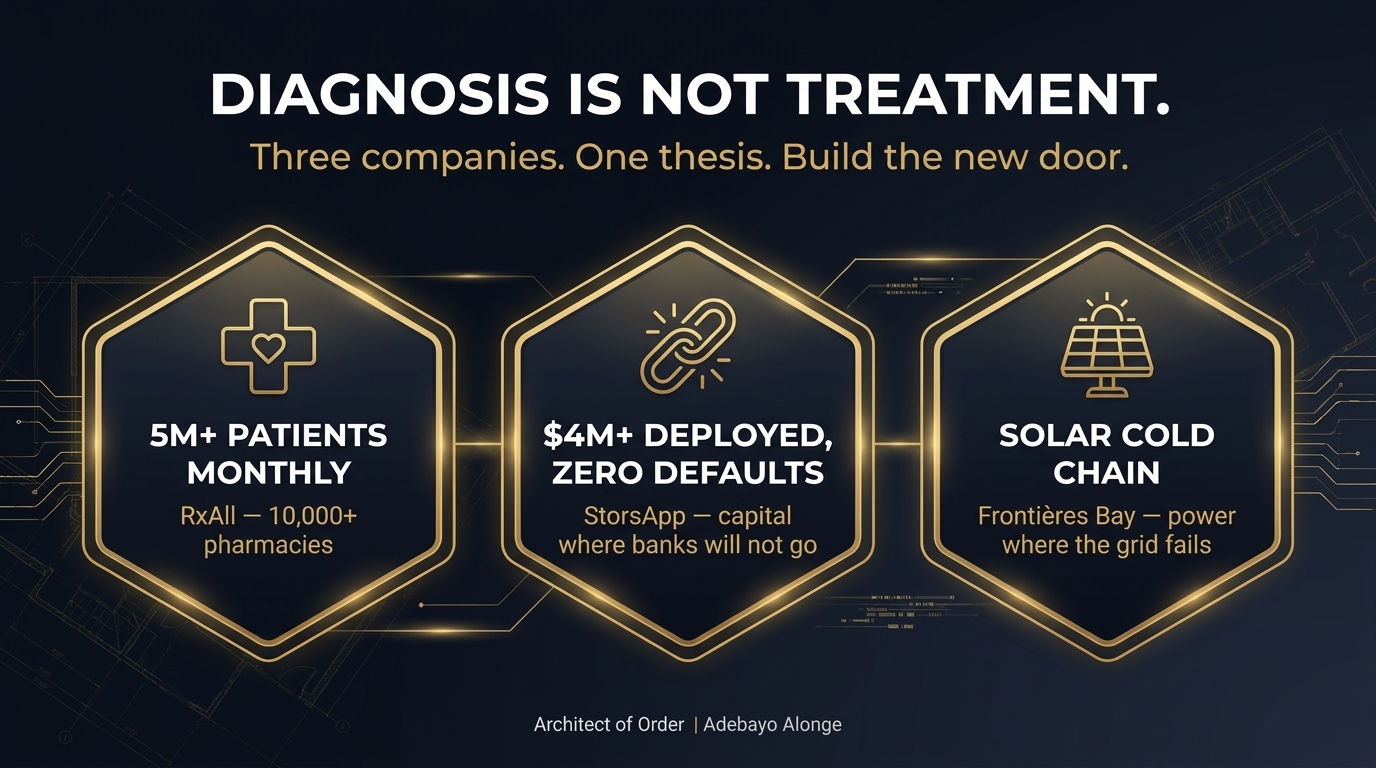
I left consulting to build. RxAll now delivers certified quality medicines to more than 5 million patients monthly across 10,000+ pharmacies, with 99.5 percent retention. StorsApp has deployed over $4 million into small businesses the banking system overlooked — with a zero default rate. Frontières Bay Energies is building solar-powered cold chain for communities the grid forgot.
Three companies. One thesis. Where the market is closed, build a new door.
What You Can Do Today
If you work inside a system you can diagnose but cannot change, ask yourself one question: is my analysis serving the architecture, or is it time to build a better one? Write down the one market absence you understand better than anyone. That absence is your company.
Consultants map systems. Builders replace them.
You cannot consult a closed market open. You must build around it.
Onwards.
Adebayo Alonge is the Founder and Group CEO of RxAll, StorsApp, and Frontières Bay Energies. A Harvard Kennedy School Mason Fellow, Yale School of Management alumnus, and MIT Legatum Fellow, he builds AI-powered platforms that deliver healthcare, capital, and clean energy to underserved markets worldwide. He has raised $11M+ from Tier 1 VCs, driven $180M+ in product sales, and serves millions of patients monthly. He is a Fast Company World Changing Ideas 2025 honoree and winner of the Hello Tomorrow DeepTech Prize.
#DeepTech #Entrepreneurship #ManagementConsulting #StartupLessons #MoralClarity
Discover more from Adebayo Alonge
Subscribe to get the latest posts sent to your email.

