“If you want to go fast, go alone. If you want to go far, go together.” — African proverb
I have heard this proverb a thousand times. I disagree with half of it.
Speed and distance are not opposites. They are design choices. And the right architecture delivers both.
Every investor call I take begins the same way. The partner leans forward, looks at the deck, and asks: you run three products in RxAll. Why?
The implication is clear. Focus is a virtue. Diversification is a risk. The Silicon Valley playbook says: pick one thing, do it better than anyone, and scale.
I understand the logic. I reject the conclusion.
Because the logic assumes these are three separate problems. They are not. Counterfeit medicines, financial exclusion, and energy poverty in healthcare are the same problem wearing different masks. They are all failures of trust at the systems level — places where institutions broke down and left people exposed.
The global counterfeit drug market exceeds two hundred billion dollars. Not because pharmaceutical science is weak. Because supply chain trust is broken.
Five hundred million small business owners worldwide operate without access to formal credit – many of whom are in health related businesses. Not because they are unworthy borrowers. Because legacy credit systems were designed to exclude them.
Thirty-five billion dollars in vaccines and food spoil every year. Not because cold chain technology does not exist. Because the infrastructure to deliver it to the last mile was never built.
Three symptoms. One root cause. Broken trust systems.
When you see the pattern, building in parallel is not distraction. It is precision.
How I Do It
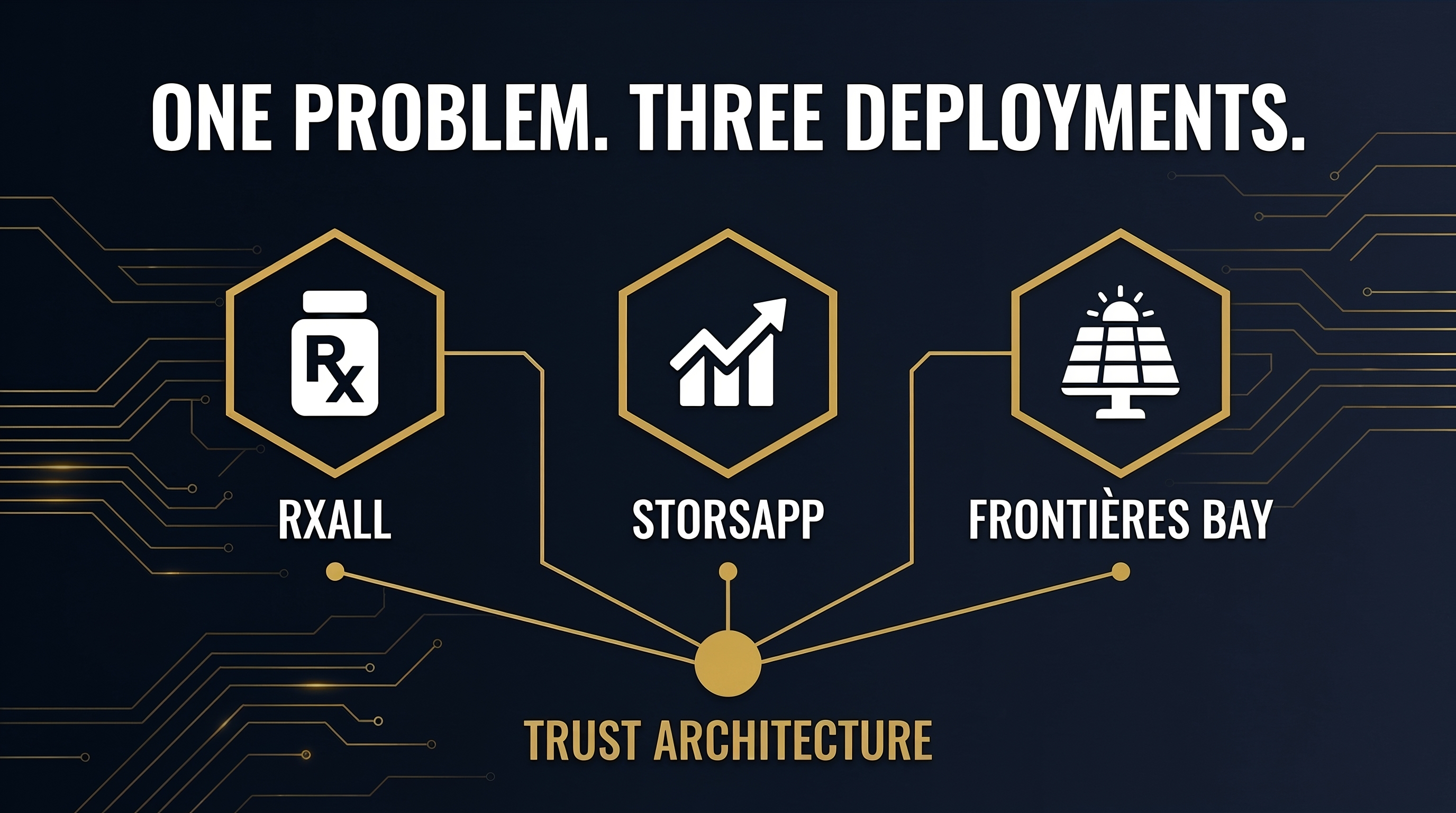
A. Build a single trust architecture, then deploy it across verticals. RxAll’s AI engine does not just authenticate drugs. It validates quality at the molecular level. The same logic — sense, verify, certify — applies to supply chains, credit, and infrastructure in healthcare. We did not build three engines. We built one engine and deployed it three ways.
B. Share infrastructure across ventures. Our data science team serves all three products. Our regulatory relationships cross-pollinate. Our distribution partnerships in ten countries serve all three products simultaneously. Shared infrastructure means lower cost per venture and faster scaling.
C. Let each product de-risk the others. RxAll generates revenue. StorsApp generates returns for investors. Frontières Bay generates infrastructure value. When one product faces a slow quarter, the portfolio absorbs it. This is not diversification for its own sake. It is antifragility by design.
D. Hire operators, not deputies. I do not run three products by doing three jobs. I run three products by hiring people who are better than I am at execution. My role is architecture — the pattern, the thesis, the strategic sequence. Their role is operations — the daily decisions that turn architecture into outcomes.
E. Maintain one calendar, one decision rhythm. Every Monday, I review all three products in a single ninety-minute session. Metrics. Blockers. Decisions. The discipline is not in working more hours. It is in compressing decision cycles so nothing waits.
The Results
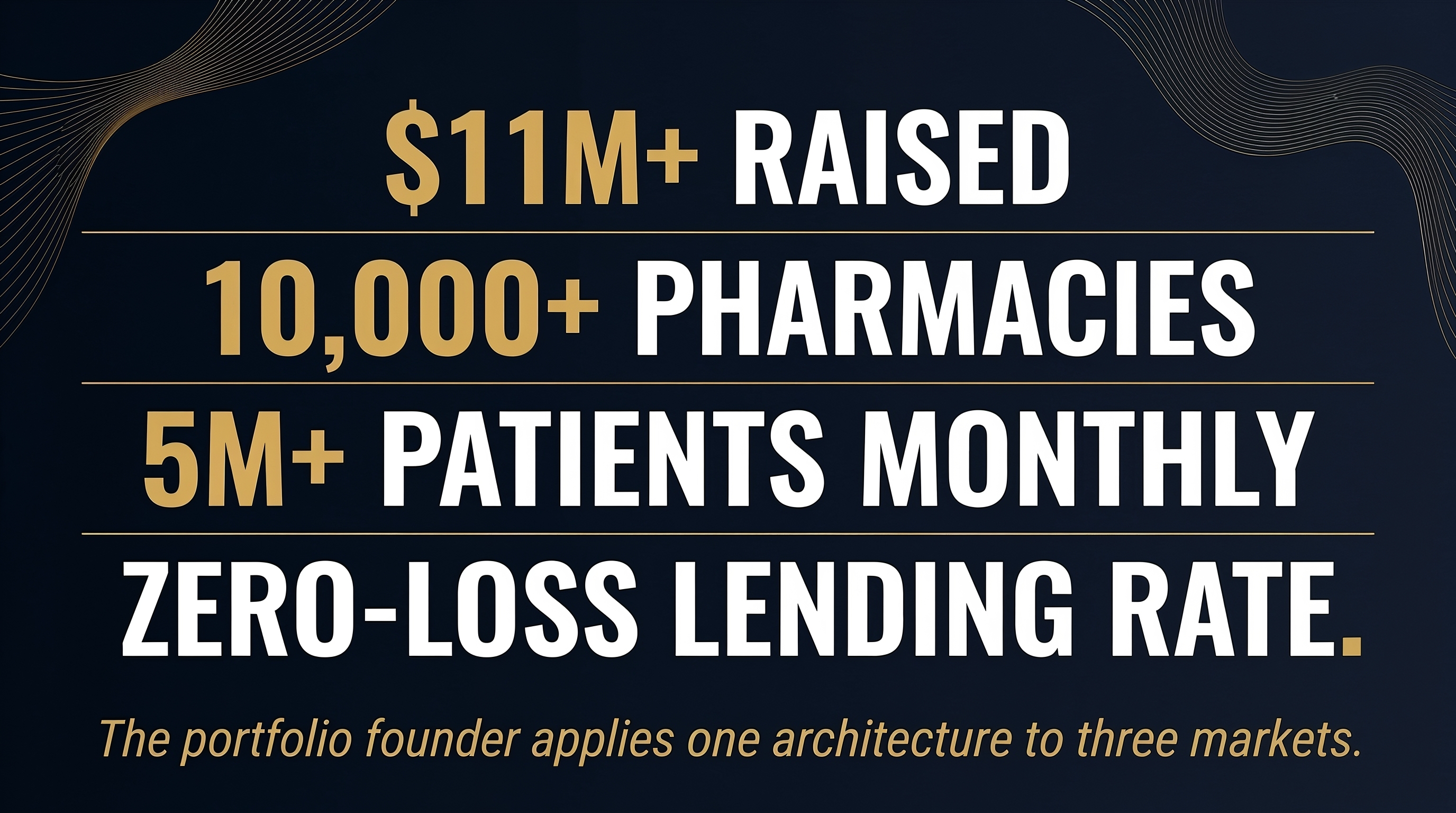
RxAll: eleven million dollars raised from Tier 1 VCs. Ten thousand pharmacies. Five million patients monthly. Ninety-nine point five percent retention. Five consecutive years of profitability.
StorsApp: four million dollars deployed. Twelve percent APY. Zero-loss rate. Six million dollars in closed enterprise lending volume.
Frontières Bay: solar-powered cold chain pilots in off-grid communities. Zero grid dependency. Zero fuel costs.
Together, these products have driven over one hundred and eighty million dollars in sales across sectors and geographies.
What you can do today
The portfolio founder model is not for everyone. It requires a specific discipline: the ability to see a single pattern underneath multiple problems and the operational rigor to build against that pattern simultaneously.
If you are a founder weighing whether to expand beyond your first product, ask yourself one question. Is the second product a different problem — or the same problem in a different market?
If it is the same problem, you are not diversifying. You are scaling your thesis.
If it is a different problem, you are splitting your attention.
Know the difference. Build accordingly.
Fake drugs, financial exclusion, and energy poverty in healthcare are the same problem wearing different masks. The portfolio founder does not chase three opportunities. The portfolio founder applies one architecture to three markets.
Onwards.
Adebayo Alonge is the Founder and Group CEO of the RxAll Group. A Harvard Kennedy School Mason Fellow, Yale School of Management alumnus, and MIT Legatum Fellow, he builds AI-powered platforms that deliver healthcare, capital, and clean energy to underserved markets worldwide. He has raised $11M+ from Tier 1 VCs, driven $180M+ in product sales, and serves millions of patients monthly. He is a Fast Company World Changing Ideas 2025 honoree and winner of the Hello Tomorrow DeepTech Prize.
#PortfolioFounder #DeepTech #AIGovernance #Entrepreneurship #ArchitectOfOrder
Discover more from Adebayo Alonge
Subscribe to get the latest posts sent to your email.

