
Trust is not a feeling. It is a system. And like all systems, it can be designed, built, and scaled.
The Problem No One Wants to Name
There is a crisis of trust unfolding across every institution that matters. And most of the people trying to fix it are making it worse.
Governments respond to public skepticism with more regulation. Companies respond with more marketing. Platforms respond with more content moderation. And yet — trust in institutions, in media, in medicine, in democratic process — continues to decline.
The 2026 Edelman Trust Barometer tells the same story it has told for a decade: the gap between what institutions promise and what people experience is widening. Not because institutions are failing more. Because people can see the failures more clearly than ever.
Deepfakes. Synthetic media. AI-generated misinformation. Counterfeit products that look identical to the originals. Financial products designed to obscure risk rather than reveal it.
We do not have a trust problem. We have a trust architecture problem.
What I Learned When 60% of Users Rejected Our Technology
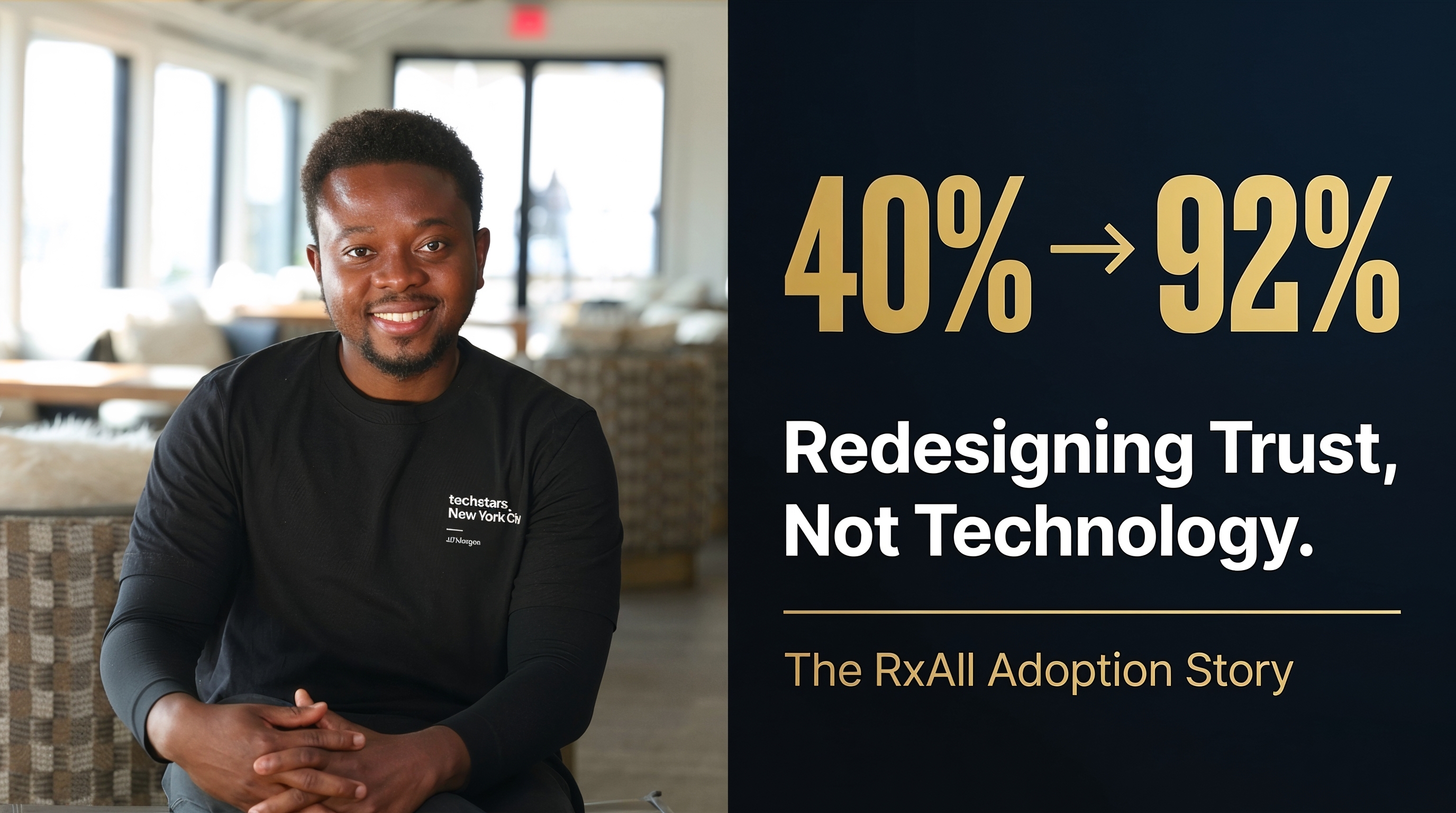
When RxAll launched its AI-powered drug authentication system, we expected adoption to follow awareness. We were wrong.
Our initial model was compliance-driven. Regulators required quality checks. We provided the technology to perform them. Simple. Logical. And 60% of pharmacists refused to use it consistently.
Not because the technology failed. Because the system around the technology failed to account for how trust actually works.
Pharmacists feared that scanning drugs would expose supply chain problems they could not control. Patients worried that a “fail” result would mean losing access to the only medicines available. Regulators wanted data but offered no protection for businesses that reported problems.
The technology was right. The architecture was wrong.
So we rebuilt. Not the algorithm — the system.
We redesigned the workflow so that pharmacists who used the scanner gained a quality certification mark — visible to customers, valuable for their reputation. Patients who scanned medicines got not just a result but a replacement pathway if a product failed. Regulators got aggregated, anonymized data that improved oversight without punishing individual actors.
Adoption moved from 40% to 92%. Not because trust appeared. Because we designed a system where trust was the rational choice for everyone involved.
The Compliance Trap

This is the lesson the global AI governance conversation is missing.
The EU AI Act — entering full enforcement on August 2, 2026 — represents the most comprehensive AI regulatory framework in the world. It classifies systems by risk level. It mandates transparency requirements. It demands human oversight for high-risk applications.
These are necessary first steps. But they are compliance steps, not trust architecture.
Compliance is what you do when someone is watching. Governance is what you build so it works when no one is.
The distinction matters because compliance creates a floor. Trust architecture creates a system. A compliance framework tells a company: “Document your AI’s decision-making process.” A trust architecture tells a company: “Build your AI so that every stakeholder — user, regulator, competitor, critic — can verify its outputs independently.”
One produces paperwork. The other produces credibility.
Three Principles for Building Trust at Scale
If you are building AI systems, deploying capital, delivering healthcare, or designing infrastructure that people must rely on, these principles apply:
A. Make verification the default, not the exception. At RxAll, every medicine can be scanned by anyone. The verification is not locked behind a login or a license. Trust scales when checking is easy and universal.
B. Design for the skeptic, not the believer. Your most important user is not the person who already trusts you. It is the person who does not. Build systems that convert skeptics through experience, not persuasion.
C. Make honesty the path of least resistance. When dishonesty is easier than transparency, your system is broken. When transparency is rewarded and opacity is costly, trust becomes self-reinforcing. This is not idealism — it is engineering.
The Builders’ Responsibility
In a post-truth world, trust is not restored by speeches, summits, or PR campaigns. It is restored by builders who design systems where credibility is structural — embedded in the architecture, not bolted on as an afterthought.
At RxAll, we authenticate medicines. At StorsApp, we deploy capital with full transparency into small businesses that the banking system has locked out — $4M+ deployed with zero defaults. At Frontières Bay Energies, we build solar cold chain infrastructure that keeps vaccines safe where the grid does not reach.
Each of these ventures is a trust architecture project. Each one proves the same thesis: when you design for credibility, adoption follows.
The future does not belong to the institutions with the best reputations. It belongs to those with the best verification systems.
Trust is not a marketing campaign. It is a design principle.
Onwards.
Adebayo Alonge is the Founder and Group CEO of RxAll, StorsApp, and Frontières Bay Energies. A Harvard Kennedy School Mason Fellow, Yale School of Management alumnus, and MIT Legatum Fellow, he builds AI-powered platforms that deliver healthcare, capital, and clean energy to underserved markets worldwide. He is a Fast Company World Changing Ideas 2025 honoree and Hello Tomorrow DeepTech Prize winner.
Discover more from Adebayo Alonge
Subscribe to get the latest posts sent to your email.

