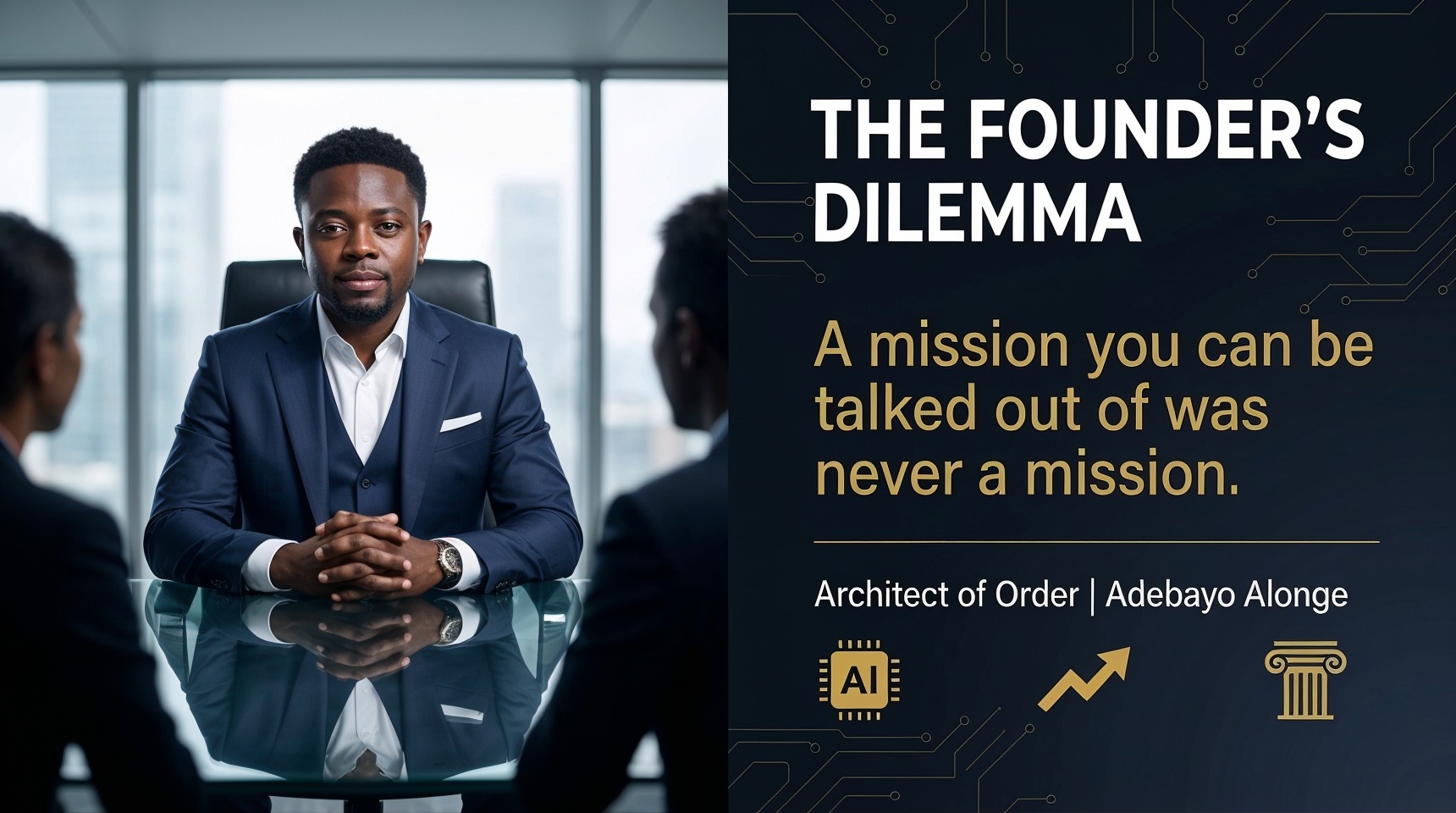
“Management is doing things right. Leadership is doing the right thing.” — Peter Drucker
Every founder can recite that line. Very few can hold it when there is money on the table and a partner across from them saying no.
I want to write about the room nobody warns you about. Not the pitch. The pitch is easy — you are selling a future and everyone is polite. The hard room comes later. The money has cleared. The board is formed. And the people who wrote the check want one thing, while the reason you started the company wants another.
That is the founder’s dilemma. Here is how I think about it after raising more than eleven million dollars, and after building through years when nobody was writing checks at all.
The power in the room is not where you think it is
Let us start with a fact that founders forget the moment they feel small.
I have never seen a successful investor without a great founder behind them. Not one. Every fund’s returns sit on the shoulders of people who built something out of nothing. The capital did not do the building. The capital arrived, took a seat, and hoped.
Now hold the other half of that fact.
I have seen many great companies built with no investors at all.
Tope Awotona built Calendly with no venture money for years. He spent his savings. He put the company on credit cards. Investors passed on him repeatedly. He built it anyway, on his own terms, and by 2021 the company carried a three billion dollar valuation with the founder still holding the outcome.
Two facts, one conclusion. Investors need founders more than founders need any particular investor.
That does not make investors the enemy. Good investors are extraordinary. They open doors, sharpen thinking, and hold their nerve in bad quarters. But you must understand the shape of the relationship before you sit down in it. You are not asking for permission. You are selecting partners.
Founders confuse mission with vision
Here is where most of the damage happens.
Founders hear “never compromise” and they apply it to everything. Then they die on a hill that did not matter. Or they hear “be coachable” and they apply that to everything, and they compromise the one thing that was never theirs to trade.
Separate the two words.
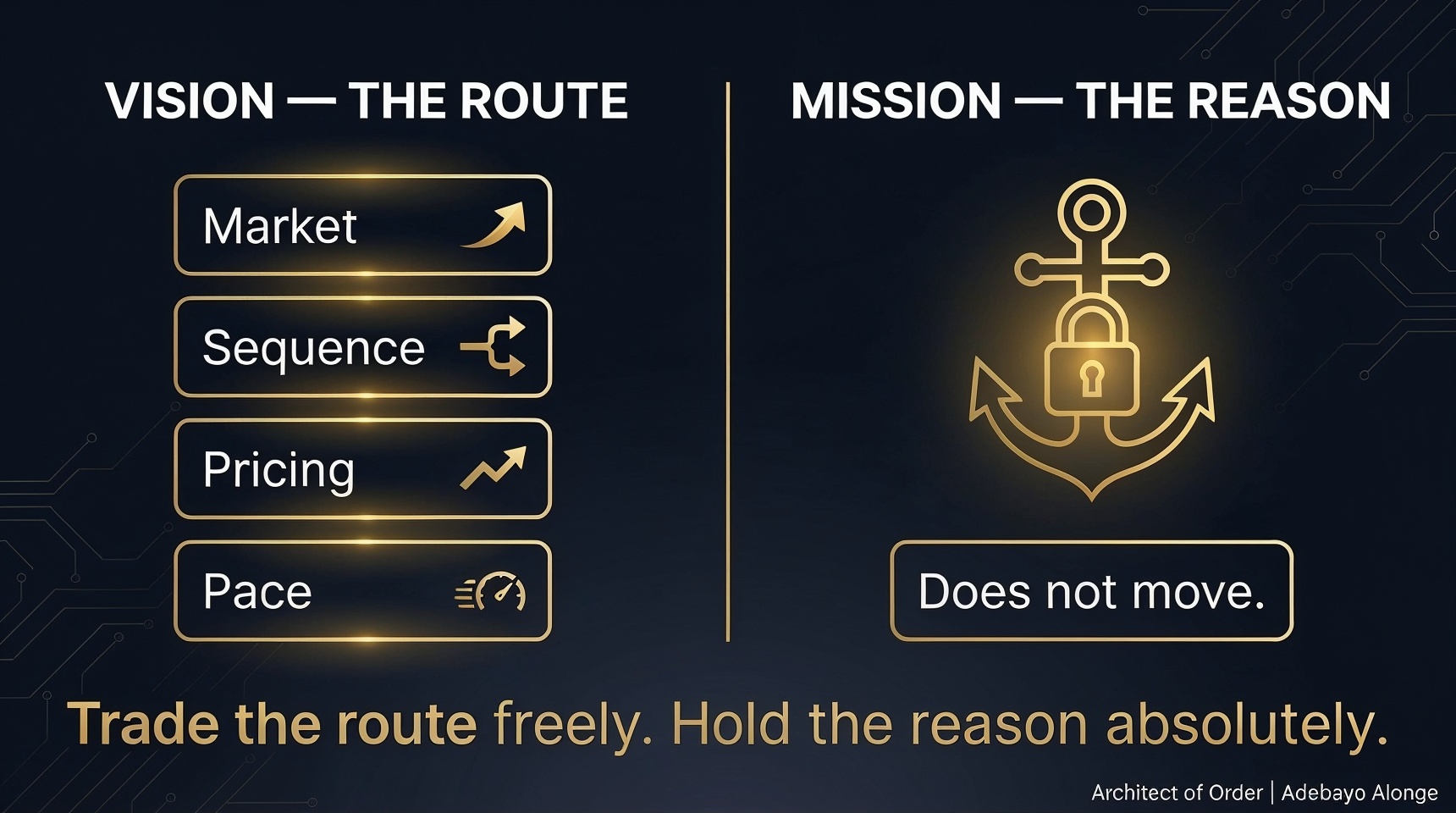
Your mission is why the company must exist. It is the harm you refuse to allow. It does not move.
Your vision is the route you picked to reach it. Market order. Product sequence. Pricing. Geography. Pace. All of that moves, and it should.
Most founder–investor fights are route arguments dressed up as mission arguments. Most founder collapses are mission surrenders disguised as being coachable.
Learn to tell them apart in the room, in real time. That skill is worth more than any pitch deck.
Seven rules for the room
A. Write the mission down before you raise. One sentence. No adjectives. Ours at RxAll: no patient should be harmed by a medicine that was supposed to heal them. Write yours, date it, and keep it where you will see it during a hard board call.
B. Diligence the investor as hard as they diligence you. Call three founders they backed — including one whose company struggled. What a partner does in a bad quarter tells you everything. What they do in a good one tells you nothing.
C. Concede route freely. Loudly. When you give ground on sequence or market or price, say so clearly and quickly. Founders who never concede anything lose credibility for the concession that actually matters.
D. Name the mission line out loud. When an ask crosses it, do not go quiet and comply. Say the sentence: “That one I cannot move, and here is why the business breaks without it.” Investors respect a stated line far more than a silent resentment.
E. Build proof faster than you build slides. Conviction without numbers is noise. Conviction with numbers is leverage. Every month of real traction moves power across the table toward you.
F. Keep one path that does not need them. Revenue, a strategic partner, a smaller round, a longer runway. A founder with an alternative negotiates. A founder with no alternative complies.
G. Go find the investors who already agree. You will not convert everyone, and you should stop trying. Keep walking your road and let your results do the recruiting. The right capital shows up for proven conviction — it just shows up later than you would like.
What holding the line compounds into
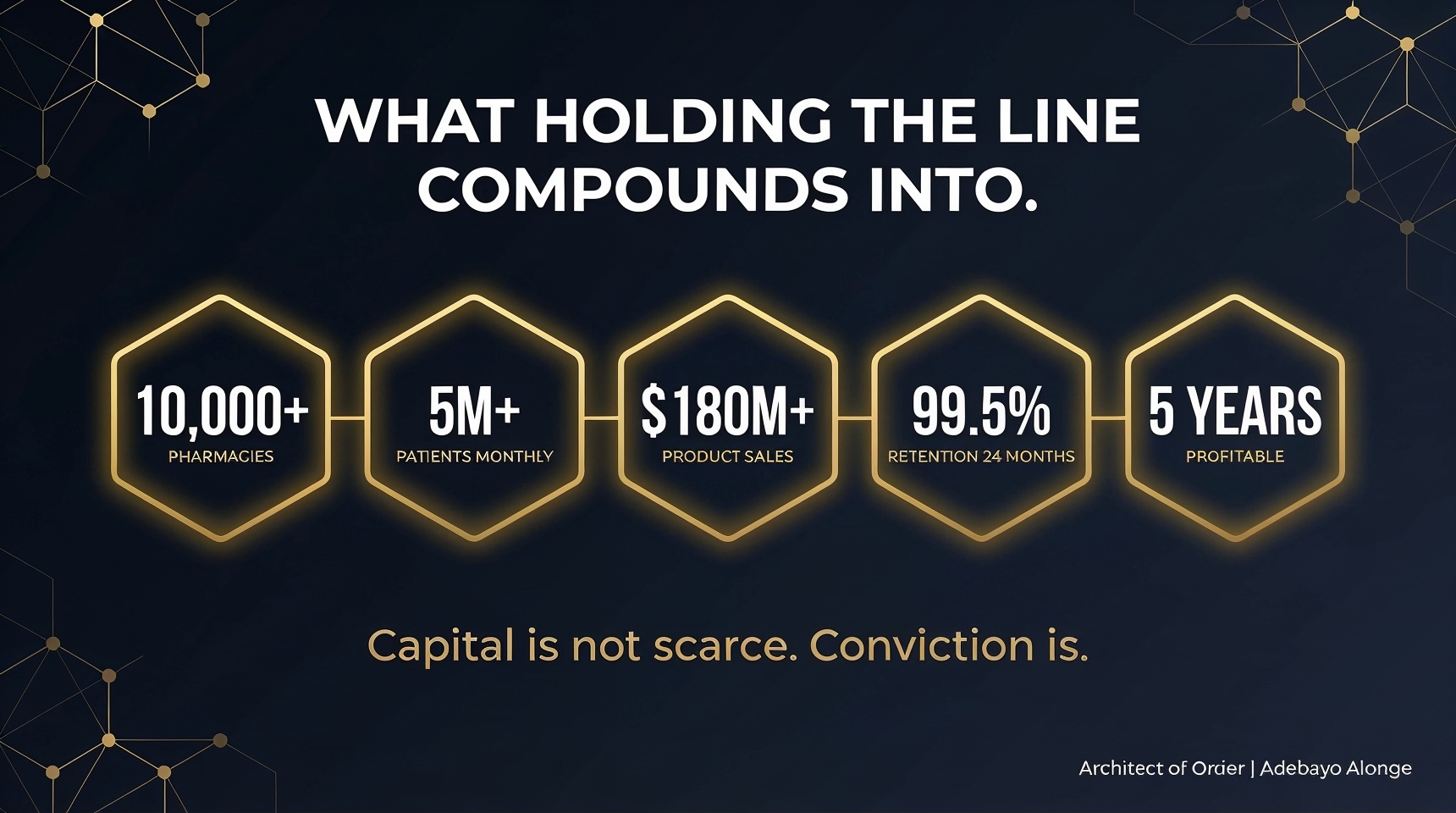
RxAll today serves more than ten thousand pharmacies and over five million patients every month. More than one hundred and eighty million dollars in product sales. Retention of 99.5 percent over twenty-four months. Five straight years of profitability.
Storspay is opening access to global markets for millions of businesses and workers in developing regions.
Investors questioned the sequence. Investors questioned the geography. Investors questioned the pace.
Nobody moved the mission. That is the only reason those numbers exist.
What You Can Do Today
Open a blank page. Write one sentence: why this company must exist. Then write three things you would trade tomorrow to protect that sentence. If you cannot fill the second list, you are not principled — you are rigid. If the first sentence is fuzzy, you are not flexible — you are unanchored.
Build until your mission is unshakable. Build until the numbers argue on your behalf. Then disagreement stops being a threat and becomes a filter.
Capital is not scarce. Conviction is.
A mission you can be talked out of was never a mission. It was a business plan.
Onwards.
Adebayo Alonge is Founder and Group CEO of RxAll Group. He is a Harvard Kennedy School Mason Fellow, a Yale School of Management graduate, and an MIT Legatum Fellow. His work has been recognised by Fast Company’s World Changing Ideas 2025 and the Hello Tomorrow DeepTech Prize. He writes Architect of Order, a newsletter on AI, capital, and the systems that govern both.
Discover more from Adebayo Alonge
Subscribe to get the latest posts sent to your email.

