
“Alberta holds the fourth-largest proven oil reserves in the world, and developing those resources benefits all Canadians. They help fund hospitals, schools, critical infrastructure and social programs across the country, while creating long-term economic opportunities for Indigenous communities through investment and co-ownership in major projects.” — Government of Alberta
Canada has flown to Abu Dhabi and to Doha to ask for investment.
Canada holds about 170 billion barrels of proven oil. The UAE holds about 113 billion. Qatar holds about 25 billion. We are asking for capital from nations that became rich selling the same resource we leave in the ground.
A nation with the fourth-largest oil reserves on Earth should not go cap in hand to anyone. Not to the Gulf. Not to Washington. Not to any single customer.
The formula we forgot
Growth has a simple equation: GDP = C + I + G + (X − M). Consumers, investment, government, and exports minus imports.
For a decade, Canada leaned on the first and third terms. It grew consumer spending by growing the population, from about 35.7 million in 2015 to 41.5 million in January 2026. It grew government spending to keep pace.
The logic was clear. A bigger tax base pays for more programs. A larger labour pool keeps wages down and profits up. Higher profits mean more corporate tax.
The result was not.
Rents rose. Emergency rooms filled. Classrooms crowded. Wages for working people stalled. And the thing that matters most, output per person, barely moved. Statistics Canada now says our productivity gap with the United States has compounded to 26% since 2000.
The headcount bet failed newcomers too. Too many skilled engineers, doctors and PhDs hit a wall called “Canadian experience” and ended up driving taxis. Too many temporary programs filled low-wage jobs instead of building new industries. A country cannot import its way to productivity. It has to build its way there.
What Harvard’s data shows
When I studied at Harvard Kennedy School as a Mason Fellow, I learned to judge an economy by what it can make, not just what it can dig. The Growth Lab’s Atlas of Economic Complexity measures exactly that. Canada’s profile is hard to read.
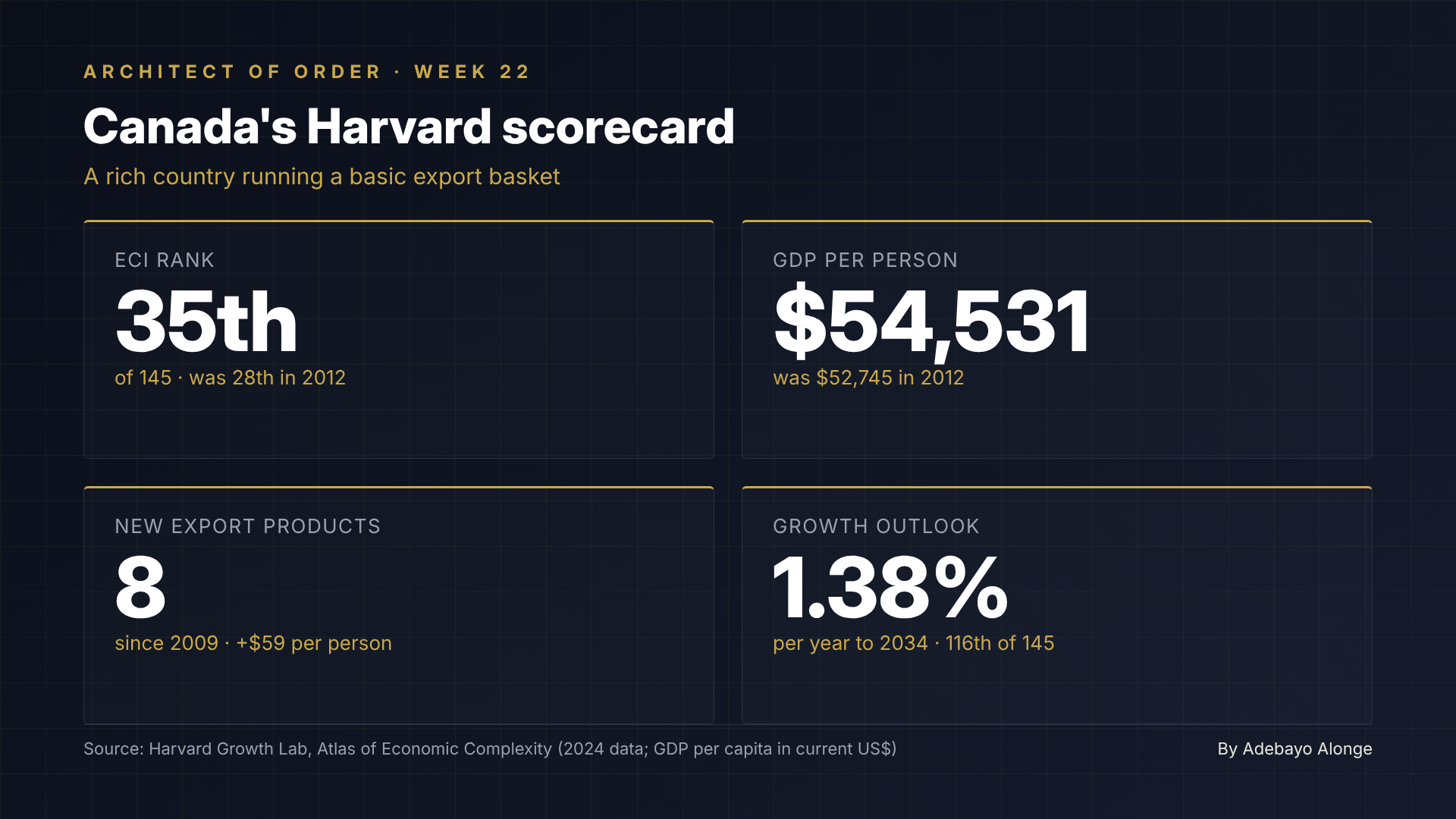
- Complexity is falling. Canada ranks 35th of 145 on the Economic Complexity Index. In 2012 it ranked 28th.
- Income is flat. GDP per person was US$52,745 in 2012 and US$54,531 in 2024. Over the last five years it averaged −0.2% a year.
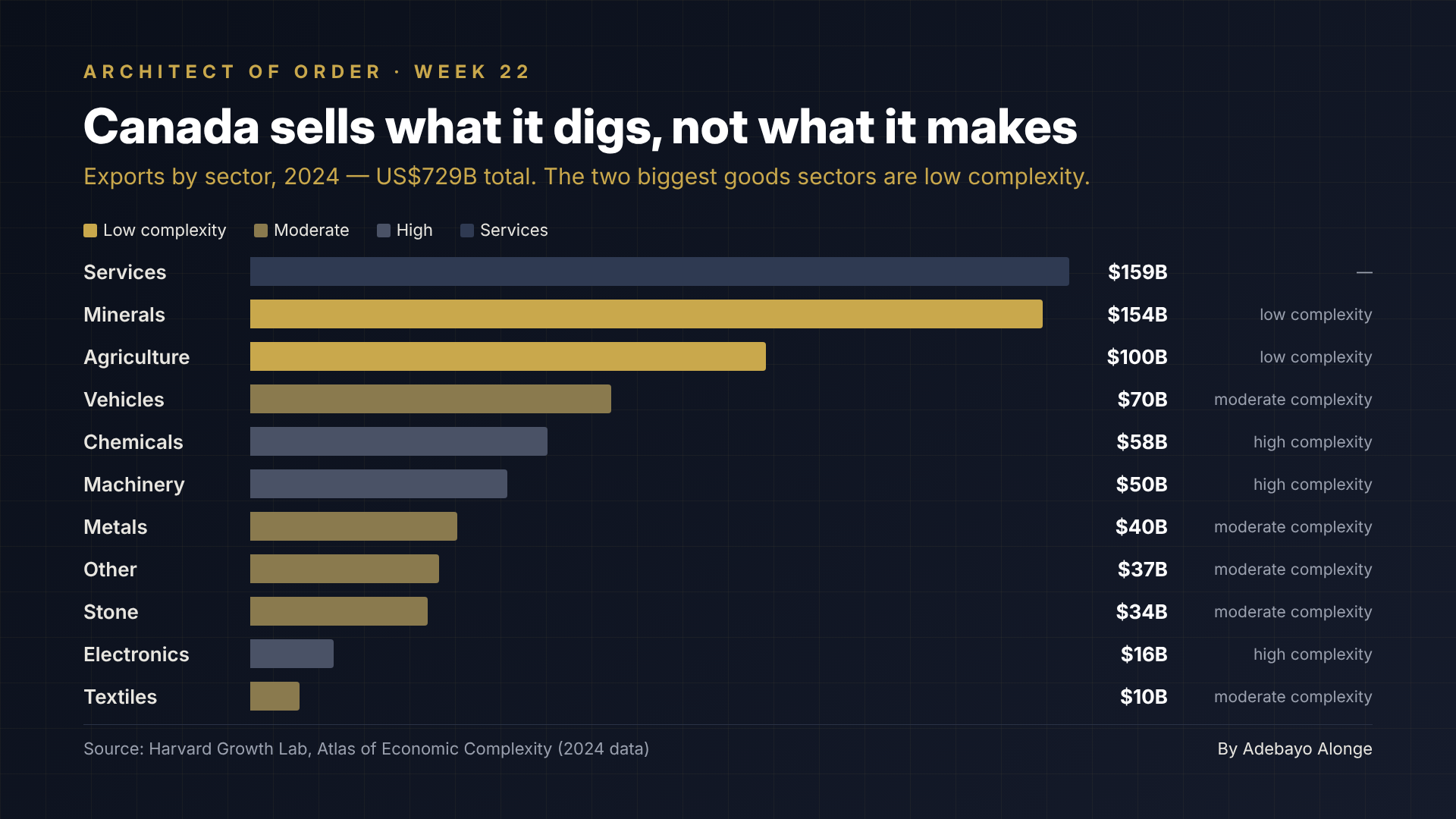
- The basket is basic. Our largest goods exports sit in low-complexity minerals and agriculture. Harvard calls Canada’s recent export growth pattern “troubling.”
- Diversification has stalled. Since 2009, Canada added only 8 new export products. Together they add US$59 per person.
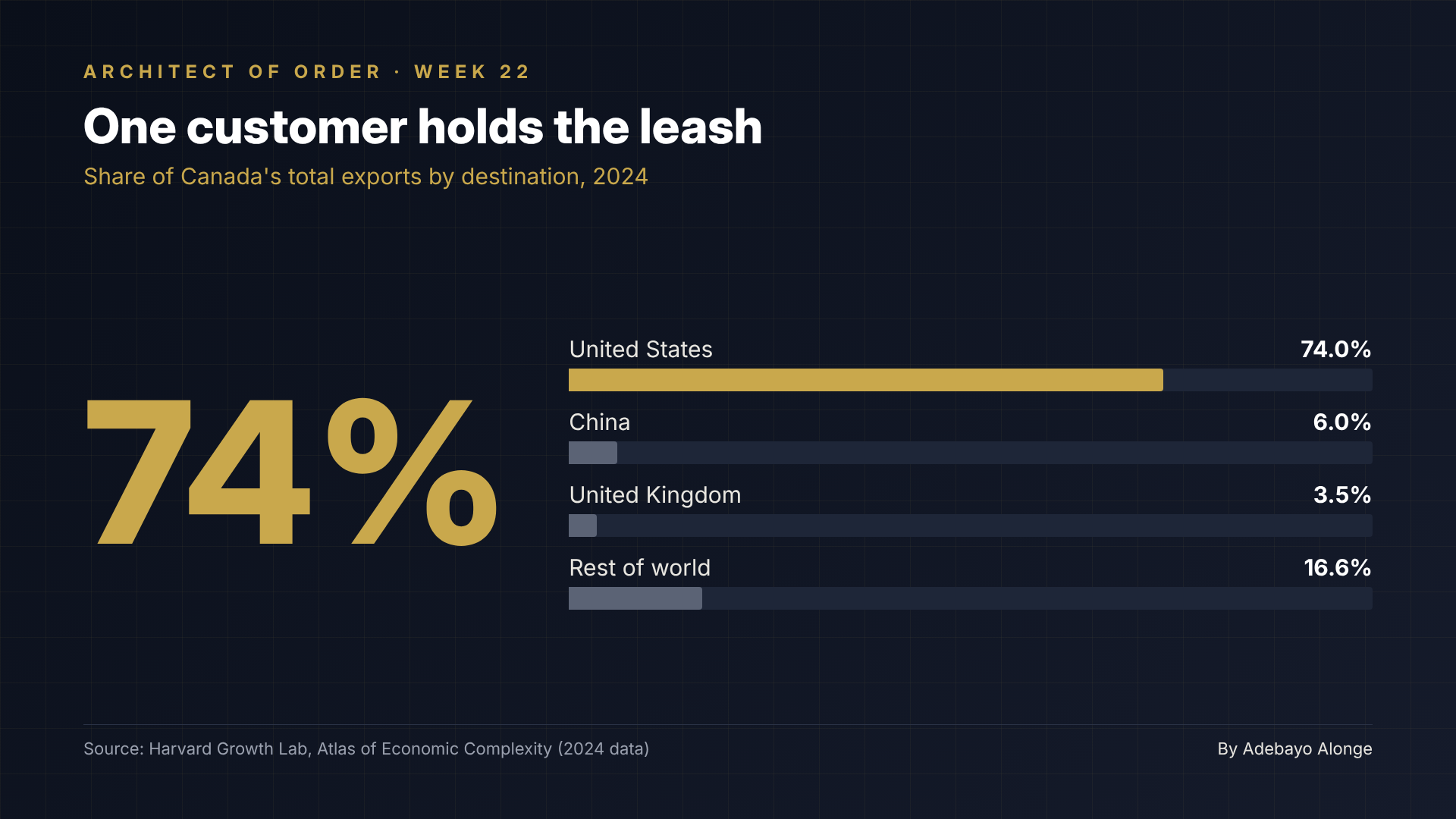
- One customer holds the leash. Almost 74% of all Canadian exports go to the United States.
- The forecast is weak. Harvard projects 1.38% annual growth to 2034. That ranks 116th of 145 countries.
Look at energy. In 2025 Canada shipped about 3.9 million barrels of crude a day to the United States. In the same year, about 383,000 barrels a day of U.S. crude flowed back into eastern Canada. We sell raw. We buy back. Lumber follows the same path: logs and rough boards go south, finished products come home.
A country that sells logs and buys back boards is not trading. It is leaking.
The Proof Is in Oslo
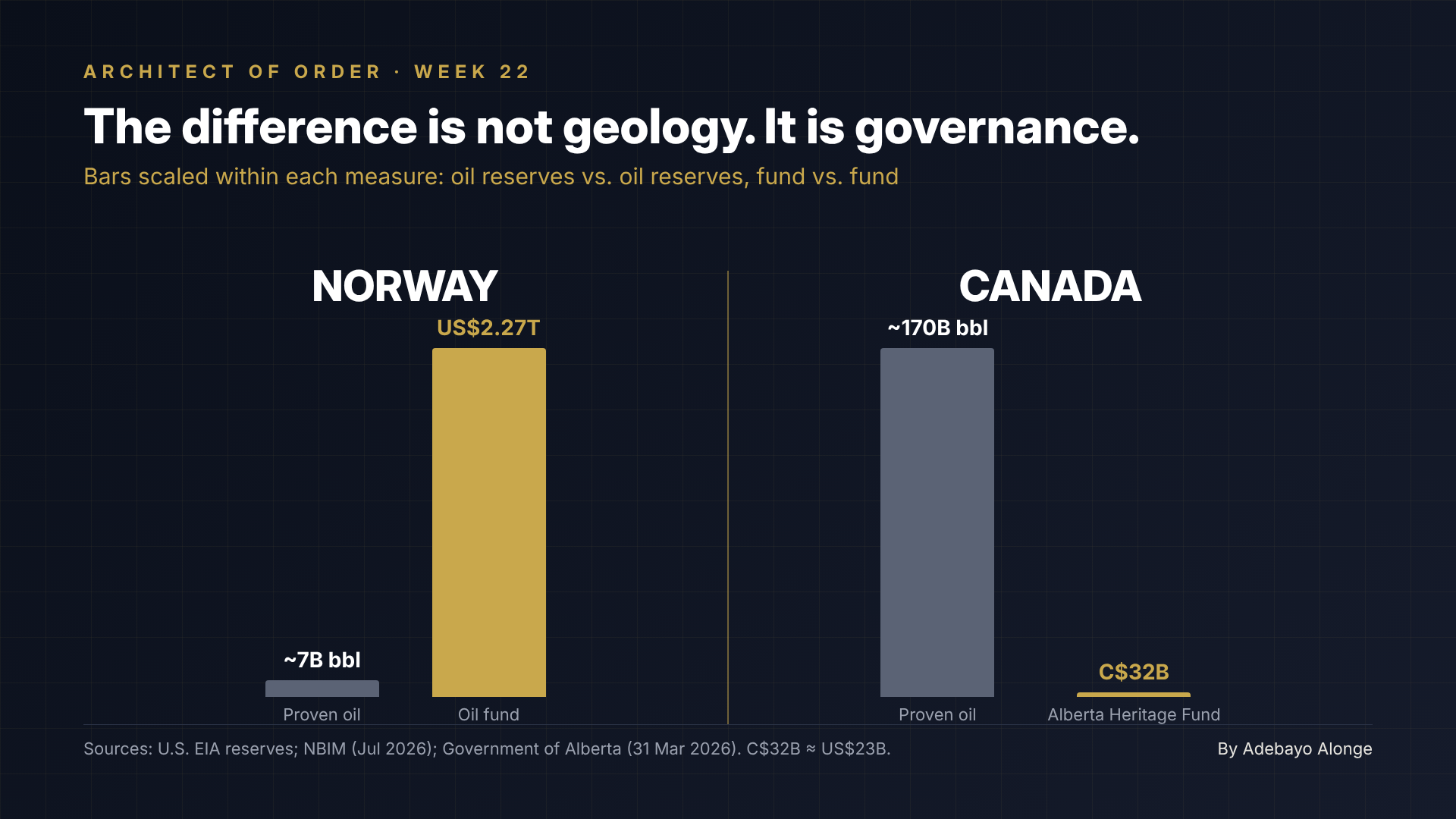
Norway holds about 7 billion barrels of proven oil. That is roughly one-twentieth of Canada’s. Yet Norway’s fund is worth more than US$2.2 trillion, over US$390,000 for every citizen. Alberta’s Heritage Savings Trust Fund holds C$32 billion.
The difference is not geology. It is governance.
Norway decided long ago that oil is a bridge, not a destination. It sells hard, saves hard, and invests with discipline. Canada has better institutions than most resource nations on Earth. We have the rule of law and low corruption. We have the talent. What we lack is the architecture.
Seven moves to own the future
A. Sell to the world. Maximize oil and gas exports to every market that will buy, through more corridors to Asia and Europe. Keep Canada’s environmental standards. Make First Nations co-owners, not bystanders. First step: fast-track one new coastal export corridor with Indigenous equity built in.
B. Split every royalty dollar three ways. One share funds hospitals, schools and social programs. One share cuts the deficit. One share seeds the fund. First step: legislate the split so no future budget can raid it.
C. Build a Canada Sovereign Fund. One national fund, arm’s-length, with Norway-style rules and public reporting. First step: grow it from today’s provincial funds and new royalty flows.
D. Beneficiate at home. Co-invest with the private sector to refine our crude, finish our lumber and process our critical minerals in Canada. Export the finished product. First step: target the refining gap that sends our crude south and brings foreign crude east.
E. Back Canadian AI and advanced manufacturing. The science behind today’s AI grew up in Toronto, Montreal and Edmonton. The trillion-dollar companies grew up in California. The fund must co-invest so our next AI champion lists on the TSX, not the Nasdaq. First step: match private capital dollar for dollar in Canadian AI, data centres and advanced manufacturing.
F. Re-platform immigration. Pause volume growth. Open the door wide for builders: founders and specialists who arrive to start export companies and hire Canadians. Let the fund co-invest beside them. First step: replace “Canadian experience” barriers with fast-track credential checks for skilled workers already here.
G. Measure the X − M. Publish a quarterly scorecard: share of exports outside the U.S., economic complexity rank, and value-added share of resource exports. First step: adopt Harvard’s complexity rank as a national target.
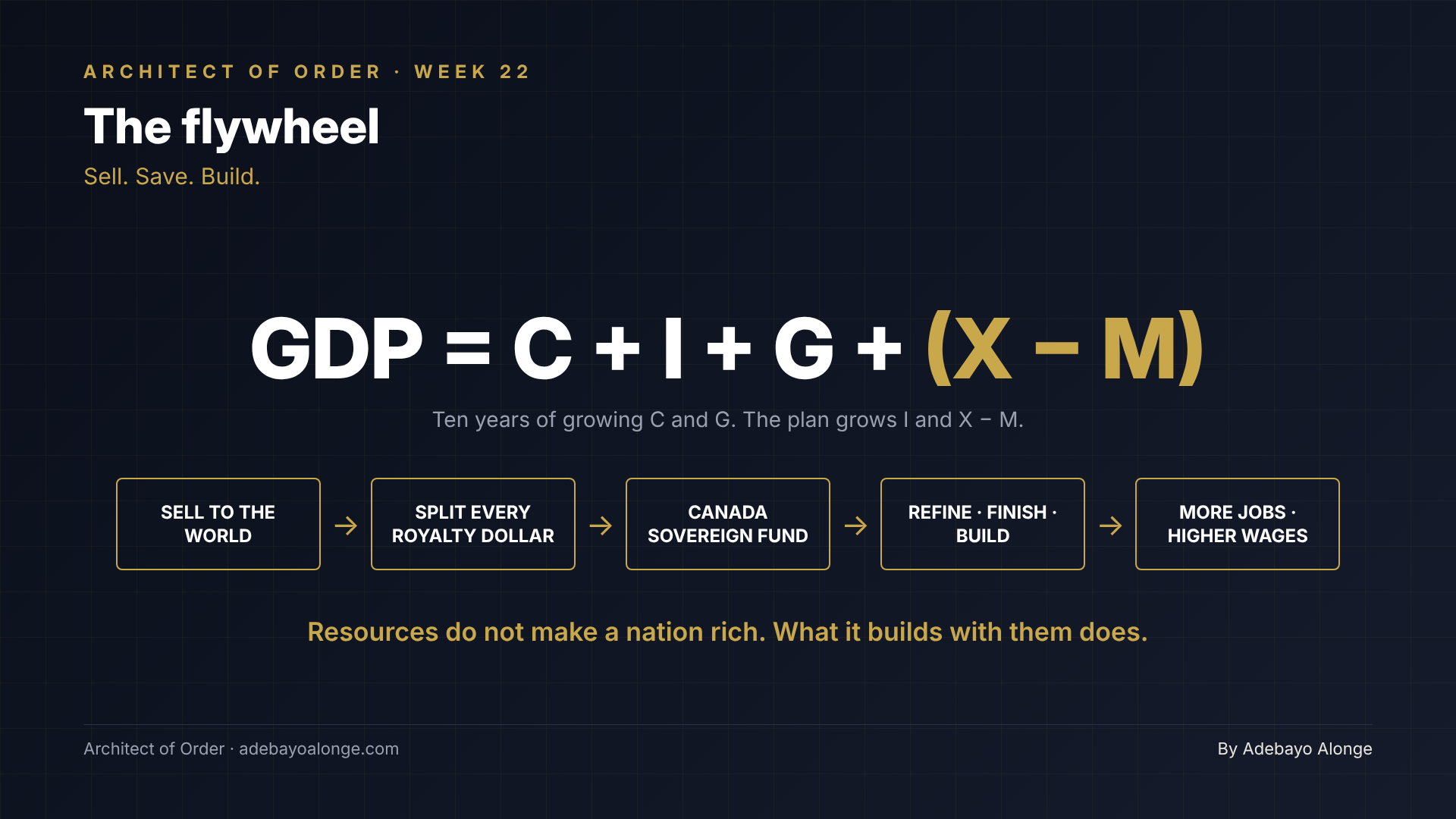
The flywheel
Sell more. Save more. Build more. More Canadians work in better jobs. Wages rise because there is more work, not more competition for it. Income tax rises. Export income rises. Government can spend on its people and still shrink the deficit. The dollar strengthens. Dependence on any one market falls.
I build companies across continents. I have seen what happens when a nation exports raw value and imports finished dignity. It always ends the same way: talented people leave, and the country waits for someone else’s capital.
Canada does not need to wait. It needs to decide.
Action Today
If you are a policymaker, put the three-way royalty split on the table this session. If you run a pension fund or a resource company, name one processing project you would co-invest in tomorrow. If you are an AI founder, build here and list here.
Resources do not make a nation rich. What it builds with them does.
Onwards.
About the author: Dr. Adebayo Alonge is an AI and DeepTech founder and Group CEO of RxAll, StorsApp and Frontières Bay Energies. He is a Harvard Kennedy School Mason Fellow, Yale School of Management alumnus and MIT Legatum Fellow. His companies have raised $11M+ from Tier 1 VCs, delivered $180M+ in product sales, and serve 5M+ patients monthly across 10,000+ pharmacies. He writes the Architect of Order newsletter on AI, governance and global systems.
Subscribe to Architect of Order: https://www.linkedin.com/build-relation/newsletter-follow?entityUrn=7353115304530485248
#Canada #SovereignWealth #EconomicComplexity #Productivity #ArchitectOfOrder
Sources: Harvard Growth Lab Atlas of Economic Complexity (Canada profile, 2024 data); U.S. EIA (2025 U.S.–Canada energy trade); Statistics Canada (population, productivity); Government of Alberta (Heritage Fund, energy); Norges Bank Investment Management.
Discover more from Adebayo Alonge
Subscribe to get the latest posts sent to your email.

