“The future of Africa is in our own hands.”
— African Union, Agenda 2063
Canada has just released its Africa Strategy: A Partnership for Shared Prosperity and Security.
Global Affairs Canada has invited me to join a high-level round table. The discussion will focus on how Canada can increase and diversify trade and investment in Africa.
This essay is my public position paper for that conversation.
It is also a call to action.
I write as:
- An African AI founder working at the frontier of health, finance and climate
- A member of the African diaspora who has lived, worked and built in several African countries and in the West
- A believer that dignity for Africans will come from good governance, accessible healthcare and fair digital trade
If Canada wants to be Africa’s partner of choice in this new age, it must move beyond mining and aid. Canada should step with us into an economy built on data, algorithms, and young talent.
In the age of AI, trade is no longer only about what we dig from the ground.
It is also about the code we write, the data we protect and the people we train.
The Moment: Why Canada–Africa Trade Must Evolve Now
Canada’s own Africa Strategy makes three facts very clear:
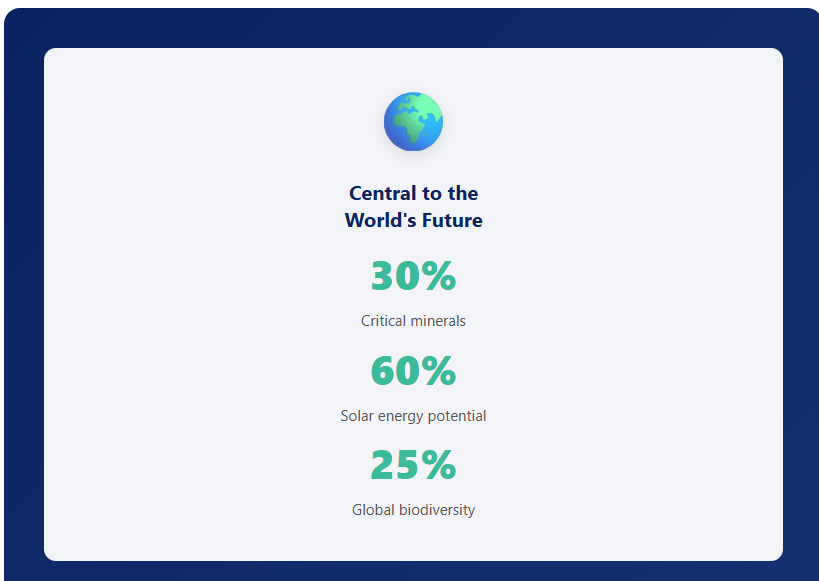


Africa is central to the world’s future
The continent holds about 30% of the world’s critical minerals. It has 60% of its solar energy potential. It also includes a quarter of global biodiversity. It is key to the green energy transition and to global food security.
Africa is young and growing fast
In less than ten years, more young Africans will enter the workforce each year. This number will surpass all young workers in the rest of the world together.
Canada is already invested—but not yet at scale
Over the past five years, Canada has invested about $4.5 billion in bilateral international assistance to Africa and now trades about $15.1 billion in goods with African countries, up nearly 30% in five years.
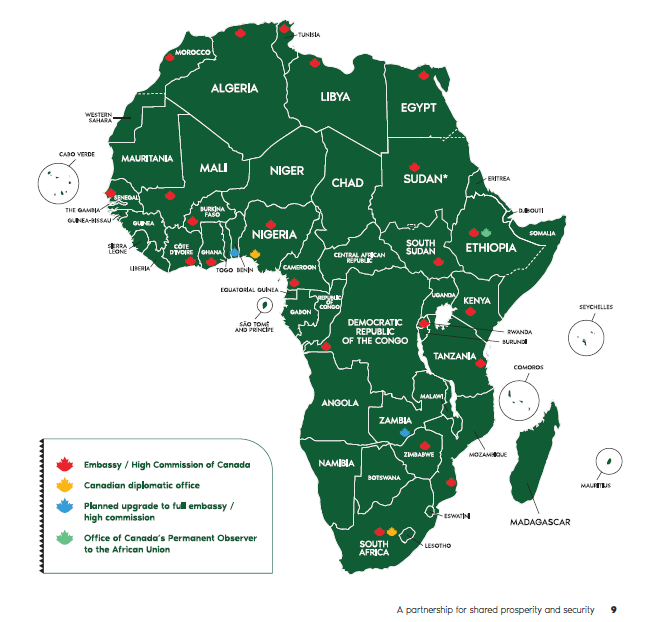
The map on page 11 of the Strategy shows new Canadian embassies and high commissions in Benin. It also shows embassies in Rwanda and Zambia. Additionally, there is a Permanent Observer to the African Union.
Canada is stepping forward.
But the world is also changing:
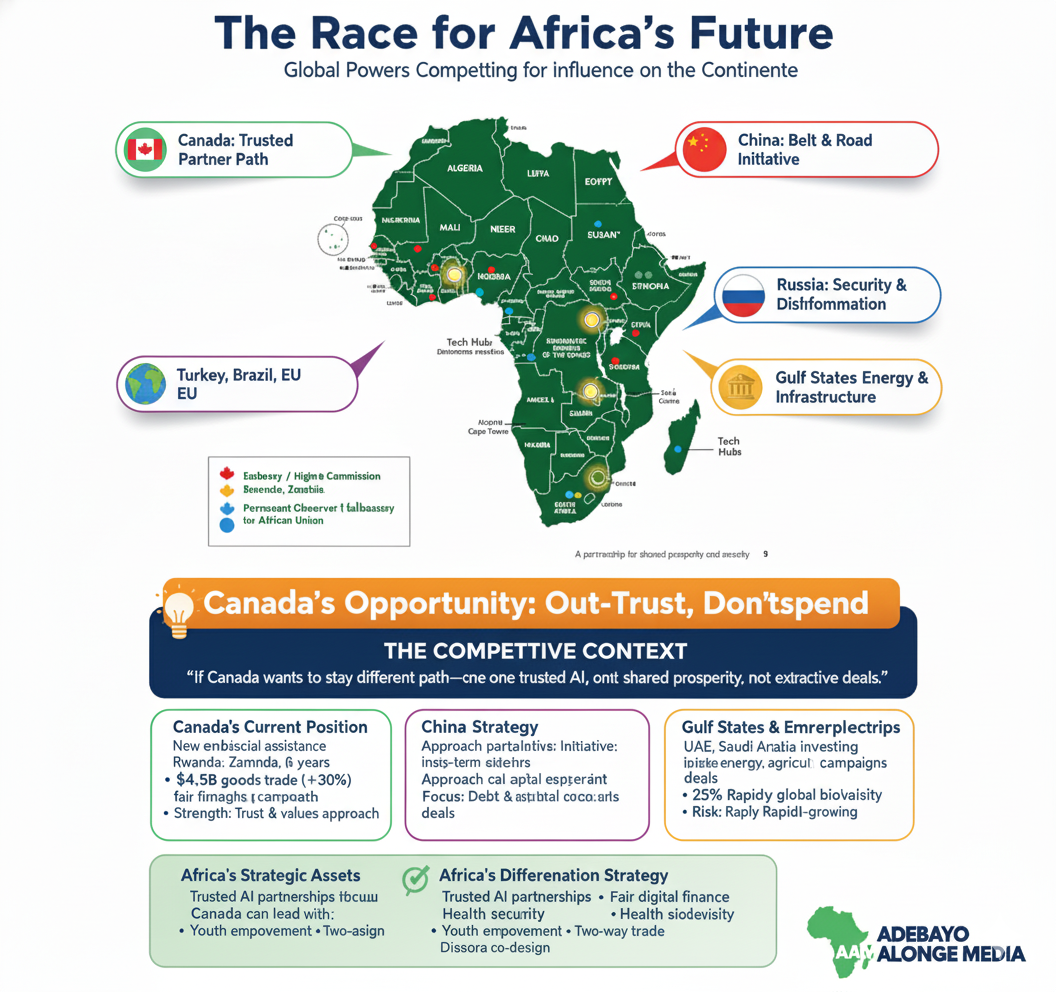
- China has used its Belt and Road Initiative to lock in long-term infrastructure and resource deals
- Russia has mixed security offers with disinformation to gain influence
- Other powers—Gulf states, Türkiye, Brazil—are racing to invest in infrastructure, energy and supply chains
If Canada wants to stay relevant, it must choose a different path. This path should be based on trusted AI, fair finance, and shared prosperity. It should not rely on extractive deals.


What Is Missing in Today’s Canada–Africa Playbook
Canada’s Africa Strategy is strong on values—peace, inclusion, climate and gender equality. It also highlights trade, AfCFTA, climate finance, FinDev Canada and critical minerals.
Yet three gaps remain.
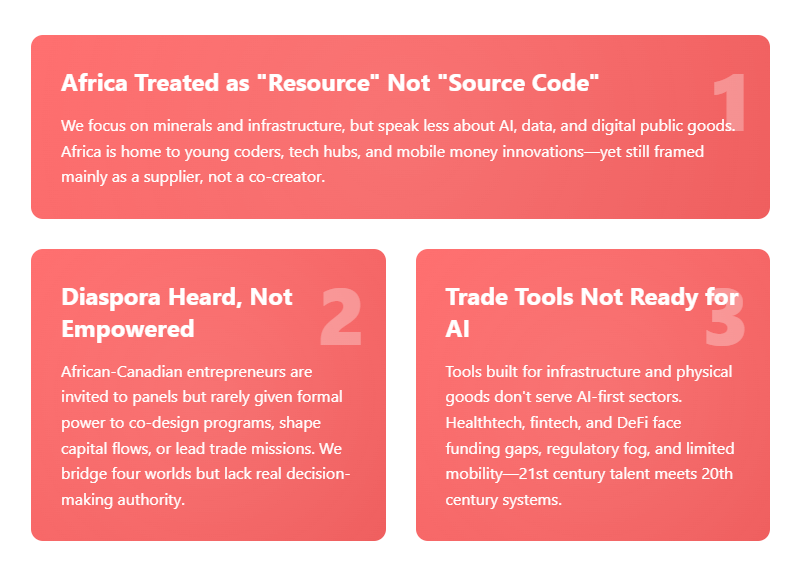
Gap 1: Africa Is Still Treated More as “Resource” Than “Source Code”
The Strategy talks in detail about minerals, energy and infrastructure. It says less about AI, data and digital public goods as core trade assets.
Africa is still framed mostly as:
- A supplier of critical minerals
- A site for renewable projects
- A recipient of development programmes
But Africa is also:
- Home to the world’s youngest coders and fastest-growing tech hubs
- A test bed for mobile money, DeFi tools and digital ID long before these were common elsewhere
- A continent where AI for health, agriculture and climate can leapfrog old systems
If we only value rocks and not rights to data and algorithms, we will repeat an old story. This story involves extraction with new tools.
Gap 2: The Diaspora Is Admired, But Not Yet Empowered as Co-Architects
Canada’s Africa Strategy says it will create a new diaspora engagement mechanism to bring in youth and business voices.
That is welcome.
But for now, diaspora entrepreneurs are still mostly invited as guests, not treated as co-designers with budget and mandate.
We sit on four bridges at once:
- Between African communities and Canadian institutions
- Between local markets and global capital
- Between traditional systems and digital tools
- Between policy rooms and last-mile clinics or farms
Without giving the diaspora real power to shape trade tools and finance instruments, Canada leaves its strongest asset under-used.
Gap 3: Trade Policy Is Not Yet Fully Aligned with AI-First Sectors
The Strategy supports AfCFTA, Foreign Investment Promotion and Protection Agreements (FIPAs), and an Africa Trade Hub.
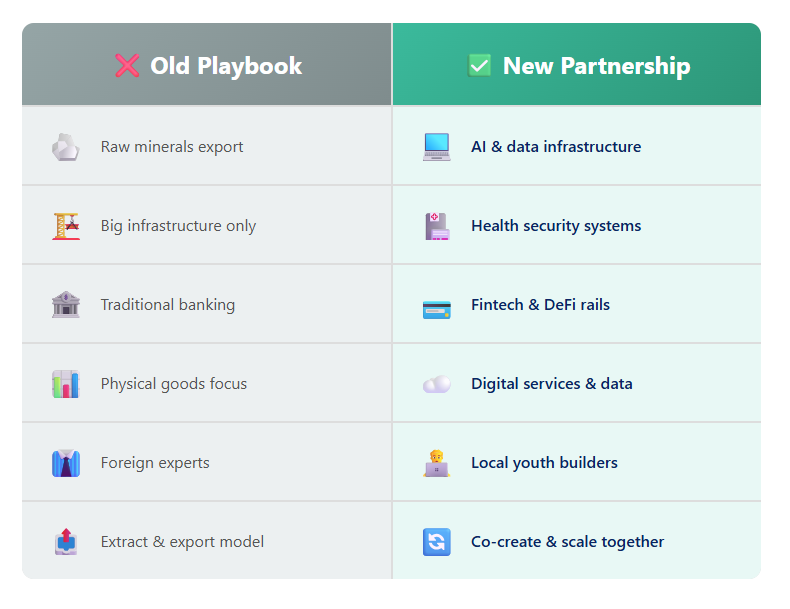
But trade rules and finance tools are still built mainly for:
- Large infrastructure deals
- Traditional banking
- Physical goods, not data-rich services
AI-first firms in healthtech, fintech, climate tech and DeFi face three barriers:
- Derisking gaps – Ticket sizes are too small for big development banks, too risky for normal banks
- Regulatory fog – Rules for cross-border data flows, AI testing and DeFi tools are unclear
- Talent visas and mobility – Young African builders struggle to move legally for short-term work, study or research in Canada
In short: We have 21st-century African talent meeting 20th-century trade tools.
Plan A–H: How Canada Can Lead a Just AI and Trade Partnership with Africa
Below is an eight-point plan I will present at the roundtable—framed in simple steps that can move quickly.

A) Anchor the Strategy in Digital and AI Infrastructure
Directive: Treat AI and digital infrastructure—data centres, connectivity, cloud, compute—as core trade and investment priorities, equal to roads and ports.
Why: Without compute, connectivity and secure data, African firms cannot build or scale AI for health, finance or climate. Trade will stay stuck in raw materials.
First step:
- Expand the planned Africa Trade Hub to include a Digital & AI window with dedicated staff who understand healthtech, fintech, DeFi and climate tech
- Co-create Canada–Africa AI infrastructure projects with the African Union and regional blocs, using blended finance to derisk early investments
B) Build Trusted Health Supply Chains, Not Just Hospitals
Directive: Make healthtech and pharmaceutical security a central pillar of Canada–Africa trade and investment.
Why: Counterfeit and poor-quality medicines kill and harm African patients and waste scarce funds. AI-powered tools can secure the medicine supply chain from factory to patient.
First step:
- Create a Canada–Africa Safe Medicines Taskforce that links Canadian regulators, African regulators, AI health startups and firms working on quality assurance and tracking
- Use FinDev Canada and the new Africa Trade and Development Program to back healthtech startups that secure drug supply chains, telehealth and diagnostics
C) Catalyze Fintech and DeFi Rails for SMEs and Climate Projects
Directive: Support digital payment rails and DeFi tools that lower the cost of trade for African SMEs and climate projects.
Why: SMEs are the backbone of African economies. They face high fees and delays when trading or raising funds in Canadian dollars or other hard currencies.
First step:
- Pilot Canada–Africa digital trade corridors where approved fintech and DeFi platforms can move small-ticket payments at low cost, under clear rules
- Involve Canadian regulators early so that innovation and consumer protection grow together
D) Back Youth and Women Builders as the Core of the Trade Strategy
Directive: Put African youth and women founders at the centre of trade and investment tools.
Why: Africa’s young people will soon be the largest workforce in the world. However, too many are shut out of skilled work and capital.
First step:
- Launch a Canada–Africa AI & Climate Corps: a programme that funds African and Canadian young professionals to co-build healthtech, fintech and climate projects in African cities and rural areas
- Tie Corps placements to real firms and real problems—drug safety, climate-smart agriculture, cross-border payments—not only to conferences
E) Use Blended Finance to De-Risk Frontier Ventures
Directive: Scale up innovative and blended finance focused on AI, health, climate and digital infrastructure in Africa.
Why: Many AI-first African firms are stuck between angel stage and large institutional capital. Canada already has tools like the International Assistance Innovation Program, FinDev Canada and its $5.3 billion climate finance envelope.
First step:
- Create an Africa Frontier Tech Window inside these instruments, with clear criteria for AI, climate tech, healthtech and DeFi ventures that show strong local value and good governance
- Open a FinDev Canada co-investment platform where Canadian pension funds and African institutional investors can join de-risked deals in these sectors
F) Tie Critical Minerals to Local Value and Clean Energy
Directive: Make every critical minerals deal a fair-value, green-value deal.
Why: Africa has many of the minerals the world needs for batteries and clean energy. But if we only export raw ore, we repeat the mistakes of the past.
First step:
- Require that Canadian-backed critical mineral projects in Africa include local processing, skills transfer and clean-energy power sources
- Link mineral projects to climate adaptation and biodiversity funds, so that nearby communities see clear benefits—schools, clinics, digital hubs—not only pits in the ground
G) Empower the Diaspora as Co-Designers, Not Just Guests
Directive: Turn Canada’s diaspora engagement plan into a formal governance role for African-Canadian entrepreneurs and thinkers.
Why: Diaspora builders know both systems. We have made payroll in Lagos and filed taxes in Toronto. We understand policy language and street language.
First step:
- Set up a Canada–Africa Digital & Health Innovation Council co-chaired by senior Canadian officials and elected diaspora entrepreneurs, with a real budget and a clear mandate to shape deals, trade missions and regulatory pilots
- Use this Council to select flagship Canada–Africa AI projects each year in health, finance, climate and public policy, with joint branding and shared accountability
H) Unlock Two-Way Youth Entrepreneurship and Fair Commodity Exports
This is the new point I want to stress.
Directive: Use Canada’s middle-power status to:
- Open Canadian markets to more African value-added commodities
- Enable Canadian youth to build export-driven businesses in Africa, under fair, modern capital rules agreed with African governments
Why it matters:
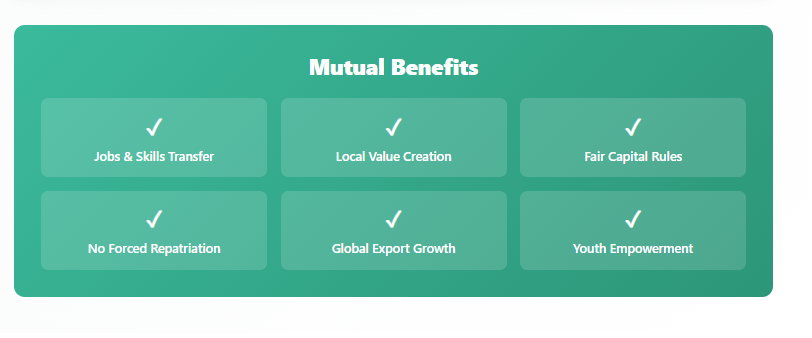
Right now, trade is still shaped by:
- Raw exports from Africa
- Finished goods imported back into Africa
- Limited chances for young people on both sides to co-build real firms
We can flip this script.

1. Open Canada Further to African Value-Added Goods
Canada can:
- Cut tariffs and simplify rules for processed African products, not just raw ones (e.g. chocolate from cocoa, shea-based cosmetics, finished textiles, processed foods, green hydrogen-based products)
- Create a Canada–Africa Fair Trade Fast Track for goods that are climate-smart, respect labour rights, and are produced by youth- and women-led firms
This would:
- Support African industrialization
- Create better jobs at source
- Bring high-quality ethical products into Canadian stores
2. Send Canadian Youth Into Africa as Builders, Not Just Volunteers
Canada can also:
Launch a “Canada Youth in Africa for Global Exports” programme.
In this programme, Canadian young people would:
- Partner with African entrepreneurs to build export-oriented companies based in African cities and towns
- Work on real supply chains: agriculture, light manufacturing, textiles, food processing, digital services
- Use Africa as a launchpad for global exports into North America, Europe and Asia
To make this work, Canada should use its diplomatic and economic clout to help agree with African governments on:
- Clear, fair capital rules for these youth-led ventures
- No forced or arbitrary capital repatriation rules that block reinvestment in local communities or choke cash flow out of Africa back into Canada
- Simple frameworks that protect African sovereignty, encourage local reinvestment and job creation, and still give Canadian youth and investors a fair and predictable return
The goal is not to pull money out of Africa fast.
The goal is to:
- Grow value in African communities
- Grow exports to the world
- Grow long-term gains for Canada and Africa together
Through this model:
- African countries get jobs, skills and higher-value exports
- Canadian youth gain global experience, new markets and real ownership in frontier ventures
- Canada deepens its position as a trusted middle power that uses its influence to shape fair, modern trade rules, not extractive deals
What Helped My Own Journey—and Where Canada Can Do More
My own path as an African AI entrepreneur has been shaped by three kinds of support:
- Access to trusted partners and mentors in both African and Western institutions
- Patient capital that understands frontier markets and does not demand quick exits
- Regulators and policymakers willing to listen and co-design rules around new technology
When these three exist together, African founders build world-class tools:
- AI that detects fake medicines
- Platforms that let farmers hedge climate risks
- DeFi rails that move cross-border payments, school fees or hospital payments at low cost
But many founders still face:
- Visa walls that block travel for pilots or investor meetings
- Banking de-risking, where global banks close doors to African clients
- Slow procurement that favours large foreign firms over African innovators
Canada can change this by:
- Making it easier for African founders with Canadian trade ties to access fast-track visas for short-term work and study
- Working with global banks to ensure risk management does not mean blanket exclusion of African fintech and DeFi innovators
- Designing public tenders that invite joint bids between Canadian firms and African AI startups, instead of only accepting foreign “turnkey” solutions
Action Today: A Compact for Shared Digital Prosperity
The Canada–Africa Strategy rightly talks about shared prosperity and security.
My simple proposal is this:
Let us turn that phrase into a Canada–Africa Digital Prosperity Compact focused on health, finance, climate and AI.
In practice, that means:
- Global Affairs Canada commits to anchor AI, digital and health security at the heart of trade and development programmes
- FinDev Canada, IDRC and climate finance instruments open clear windows for frontier tech in Africa—backed by blended finance
- African Union and regional economic communities co-lead in choosing priorities and in evaluating impact
- Diaspora entrepreneurs gain formal seats at the table, with power to help design and deliver
If we do this, Canada will no longer be seen only as a kind donor or polite partner. Instead, it will become a bold co-builder of Africa’s digital future.
And African youth will see Canada not only as a place to migrate to. They will view it as a country that believes enough in them to build with them—where they are.
The Real Border in the 21st Century
In the age of AI, true power is no longer in the resources you extract. It lies in the futures you choose to co-create.
The real border in the 21st century is not between nations. It is between those who build fair digital systems and those who live under them.
Onwards.
Share This Vision
Have thoughts on this proposal? Join the conversation in the comments below or reach me at: RE:Canada–Africa Digital Prosperity Compact – Position Paper from Adebayo Alonge via LinkedIN
Discover more from Adebayo Alonge
Subscribe to get the latest posts sent to your email.

